
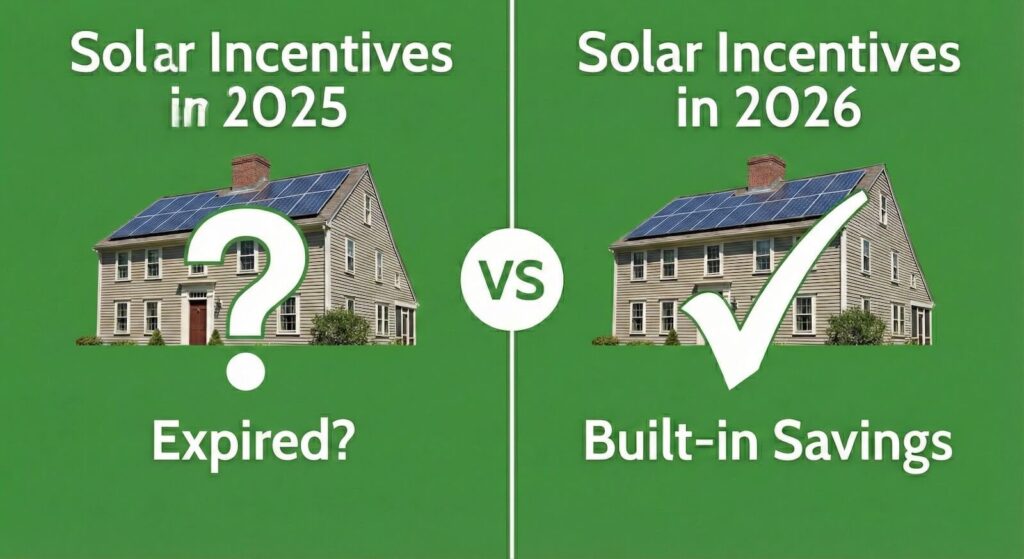
Solar tax credit vs built‑in incentives: the real differences in 2026
Comparing the legacy homeowner-claimed solar tax credit to today’s built-in federal incentives through five lenses that actually affect your bill and your time.
Heard conflicting advice about the “old” solar tax credit versus today’s built‑in incentives? You’re not alone. When the homeowner-claimed credit expired after 2025, many people assumed the value disappeared. It didn’t. It shifted. And that shift changed who does the paperwork, when you see savings, and how predictable your costs are.
The real differences show up in five areas that matter day to day: timing, risk and admin effort, credit and insurance implications, protections, and cash‑flow predictability. You’ll also see a quick table, a responsibility checklist, and a comparison example of two homeowners who took different paths.
For bigger‑picture context, our comprehensive guide to the new solar incentive landscape explains how incentives evolved and why programs look different today. Learn more in the new solar incentive landscape after 2025.
Timing: when the benefit hits your wallet
Here’s the thing: both approaches reflect federal support for going solar. The difference is when and how you receive it. With Legacy Ownership, you paid for a system and later claimed a credit when you filed taxes, assuming you had enough tax liability. With Incentive-Backed Solar™, the federal incentives are built into the plan from day one, so you don’t wait or file for them.
| Aspect | Legacy tax credit (through 2025) | Built‑in incentives (2026) |
|---|---|---|
| When applied | At next tax filing (months later) | Immediately within the plan |
| Cash needed upfront | Often $20k–$40k (cash) or loan | $0 upfront in most plans |
| First-year bill impact | Depends on loan payment and taxes | Programmed to beat your utility bill |
| If tax liability is low | Credit limited; carryover required | No dependency on your tax profile |
| Administrative steps | Collect forms, file, track carryover | None, incentive applied automatically |
Illustrative scenario: Mike (2024) vs Dan (2026)
Mike installed a solar system in late 2024 with a loan. He expected a credit worth about 30% when he filed in 2025. Until then, he paid his loan plus the utility’s minimal connection fees. His savings were spread over time, and tied to tax filing and liability. If his liability was lower than expected, some of that value might carry over to future years.
Dan went solar at the end of 2025 with Incentive‑Backed Solar. The federal incentives were baked into his plan from day one. He put $0 down and started with a monthly solar payment designed to beat his utility. No forms, no waiting, no hoping the numbers line up at tax time. Different paths, similar federal value. The timelines and certainty are very different.
Risk and admin effort: who carries the load
Under Legacy Ownership, homeowners did more of the heavy lifting: filing for the credit, coordinating warranties, and handling maintenance logistics. With Incentive‑Backed Solar, the provider shoulders more responsibility, including performance guarantees and repairs.
Here’s a simple responsibility checklist comparing roles:
- Filing for federal benefits:
- Legacy Ownership: homeowner files.
- Incentive‑Backed: provider applies benefits within the plan.
- Audit risk related to claims:
- Legacy Ownership: homeowner bears it.
- Incentive‑Backed: not applicable to you.
- System performance monitoring:
- Legacy Ownership: usually the homeowner.
- Incentive‑Backed: active provider monitoring.
- Repair coordination and cost:
- Legacy Ownership: homeowner arranges, warranty may or may not cover.
- Incentive‑Backed: provider handles under the plan.
- Production shortfalls:
- Legacy Ownership: homeowner risk.
- Incentive‑Backed: covered by a production guarantee.
- Paperwork and ongoing admin:
- Legacy Ownership: multiple parties, homeowner led.
- Incentive‑Backed: centralized with the provider.
The upshot: the Incentive‑Backed model shifts risk and admin to the program, so homeowners spend less time managing and more time just… paying a lower bill.
Credit and insurance implications
Legacy Ownership often meant a loan. That loan could appear on your credit report, affect your debt‑to‑income ratio, and show up during a mortgage application or refinance.
Incentive‑Backed Solar is not a loan. There’s no new debt on your credit report and no lien on your home. That preserves buying power and simplifies conversations with mortgage lenders. If you decide you want to own the system later, there’s flexibility to buy it out, similar to a vehicle lease.
Insurance is another difference. With Legacy Ownership, panels can be treated as homeowner property for homeowners insurance, which may nudge premiums up. With Incentive‑Backed Solar, panels usually aren’t added as a personal asset, so premiums typically don’t change. Always check with your insurer, because policies vary by carrier and state.
Quick Answer
If you want to avoid new debt, potential liens, and premium surprises, the built‑in incentive path usually keeps things cleaner.
Protections and coverage you can count on
Legacy Ownership hinged on equipment warranties, usually strong on panels, shorter on inverters. If something broke outside warranty, the repair bill was yours. Production wasn’t guaranteed; it was estimated. Weather and equipment issues shifted more risk to you.
With Incentive‑Backed Solar, protection isn’t just about hardware. Plans typically include a 25‑year production guarantee, continuous monitoring, and full‑coverage service. If production falls short due to covered causes, the provider makes it right. If an inverter fails, it’s replaced and coordinated by the program.
Think of it this way: Legacy Ownership was a product purchase with separate warranties. Incentive‑Backed Solar is an end‑to‑end energy service with built‑in accountability. The goal isn’t just working equipment: it’s guaranteed outcomes.
- Monitoring: provider watches system health
- Repairs: coordinated and covered under the plan
- Performance: backed by a 25‑year production guarantee
- Home sale: plan is transferable to the next homeowner
Cash‑flow predictability and planning
For most households, predictability is the deciding factor. Under Legacy Ownership, your monthly picture depended on a loan payment, actual solar production, utility rates, and timing of any credit carryover. You could save, but the path had more moving parts, and more personal risk if production or equipment didn’t cooperate.
With Incentive‑Backed Solar, the plan is designed to beat your current utility costs from day one, with incentives already integrated. Many programs outline a clear rate path for the next 10–25 years. You can compare that to historical utility increases and decide what level of certainty you want.
Key Takeaway
Built‑in incentives shift solar from “save later if everything lines up” to “save now with a defined payment and protection.” That’s cash‑flow certainty you can budget around.
A simple decision framework
- Want $0 upfront, day‑one savings, and minimal admin? Incentive‑Backed Solar fits.
- Prefer no new debt on your credit report? Incentive‑Backed Solar keeps it clean.
- Need predictable costs with performance guarantees? Incentive‑Backed Solar provides both.
- Insist on owning the asset from day one and comfortable managing warranties? Legacy Ownership is still available.
- Have the cash to buy outright and willing to handle maintenance? Legacy Ownership can work, just know the incentives aren’t homeowner‑claimed anymore. Or, ask about buyout options with Incentive-Backed Solar.
If you’re unsure which bucket you’re in, a quick fit check can help. You can connect with our team to see which option is best for you. Start with a free quote here.
The bottom line: different paths, clearer choice
The federal value that once came through a homeowner-claimed tax credit didn’t vanish, it changed channels. With Incentive‑Backed Solar, incentives arrive automatically, timelines accelerate, and more responsibility shifts to the provider. That means fewer forms, fewer what‑ifs, and a payment designed to beat your utility from day one.
Here’s the short version of solar tax credit vs incentives in 2026:
- Timing: Legacy Ownership paid you back later; Incentive‑Backed applies benefits now.
- Risk/admin: Legacy Ownership relied on you; Incentive‑Backed shifts duties to the program.
- Credit/insurance: Legacy Ownership often added debt and potential premium changes; Incentive‑Backed avoids both in most cases.
- Protections: Legacy Ownership relied on equipment warranties; Incentive‑Backed adds production guarantees and full coverage.
- Cash‑flow: Legacy Ownership could save depending on variables; Incentive‑Backed is built for predictable, immediate savings.
For the full picture, explore our guide to the new solar incentive landscape.
Ready to see how Incentive‑Backed Solar™ works for your home? Learn more about Incentive‑Backed Solar™.
