Key takeaways
- Energy Storage Solutions is Connecticut's home battery program, run by the Connecticut Green Bank, Eversource and UI. For new enrollments from April 1, 2026, it pays an upfront incentive of $30 per kWh of battery capacity, or $130 per kWh for Grid Edge customers, plus performance payments for 10 years.
- The performance incentive is $300 per kW-year for most homes, $450 for customers in underserved communities and $550 for low-income customers, as of October 2026. It's based on how much power your battery averages during active dispatch events, and it's paid twice a year, after the summer and winter seasons.
- Grid Edge customers live on circuits in the top 10% for storm outages, either how often they happen or how long they last, since July 1, 2012. They get the higher $130 per kWh upfront incentive. The program publishes circuit maps, and an eligible contractor can check your address.
- The program is separate from RRES, Connecticut's solar incentive, and you can use both. Solar isn't required to join. A battery can be financed with a Smart-E Loan, and a battery in a lease or PPA can still qualify for the 30% federal credit, which lowers what you pay.
What is Connecticut's Energy Storage Solutions program?
Energy Storage Solutions is Connecticut's program for home and business batteries. It pays you to install a battery and then pays you again, for up to 10 years, to let your utility draw on it when the grid is stretched thin. The Connecticut Green Bank, Eversource and UI run it, the Public Utilities Regulatory Authority (PURA) oversees it, and electric ratepayers fund it.
The program changed on April 1, 2026. The upfront incentive got smaller, the yearly performance payments became the main reward, and homes on the most outage-prone circuits now get a much larger upfront amount. Many installer websites still show the older, larger upfront numbers, so check the date on anything you read.
If you're still deciding whether a battery makes sense at all, start with our guide to solar batteries and backup power. This article covers the Connecticut program in detail.
What does Energy Storage Solutions pay in 2026?
For homes that enroll on or after April 1, 2026, the program pays in two parts. The figures below are as of October 2026.
| Customer | Upfront enrollment incentive | Performance incentive (10 years) |
|---|---|---|
| Most homes | $30 per kWh of battery capacity | $300 per kW-year |
| Grid Edge homes | $130 per kWh of battery capacity | Same as your customer class |
| Underserved communities | $30 per kWh ($130 if Grid Edge) | $450 per kW-year |
| Low-income customers | $30 per kWh ($130 if Grid Edge) | $550 per kW-year |
The enrollment incentive is based on your battery's rated storage capacity in kilowatt-hours. It usually shows up as an upfront discount in your contract with the installer or the company that owns the system.
The performance incentive is based on the average power, in kW, your battery delivers during dispatch events. Underserved communities are the state's distressed municipalities, and the low-income rate is for customers on an Eversource or UI low-income discount rate. The program notes that some battery manufacturers keep a portion of the performance payment, so ask your installer.
An illustrative example
Say you install a battery rated at 10 kWh, and it averages 3 kW across a year's events. The enrollment incentive would be about $300, or about $1,300 on a Grid Edge circuit. At $300 per kW-year, the performance incentive would be about $900 a year, or about $9,000 over 10 years if the battery kept performing the same way. This is an example, not a promise: batteries lose some capacity as they age, and skipped events lower the payment.
Homes that applied before April 1, 2026 stay on the earlier "legacy" terms, which paid a larger upfront incentive and smaller ongoing payments.
What is a Grid Edge customer, and do you qualify?
Grid Edge customers are homes on circuits that lose power more often, or for longer, in big storms. A circuit qualifies if it ranks in the top 10% for either the number of outages per customer during major storms or the length of those outages, counting from July 1, 2012.
For these homes, the upfront incentive jumps from $30 to $130 per kWh. That's the program's way of putting batteries where backup power matters most.
The program publishes maps of the qualifying Eversource and UI circuits in the resource library on energystoragect.com. Circuit maps can be hard to read for a single address, so the simplest check is to ask an eligible contractor to confirm whether your home is on a Grid Edge circuit before you sign.
What happens during a dispatch event?
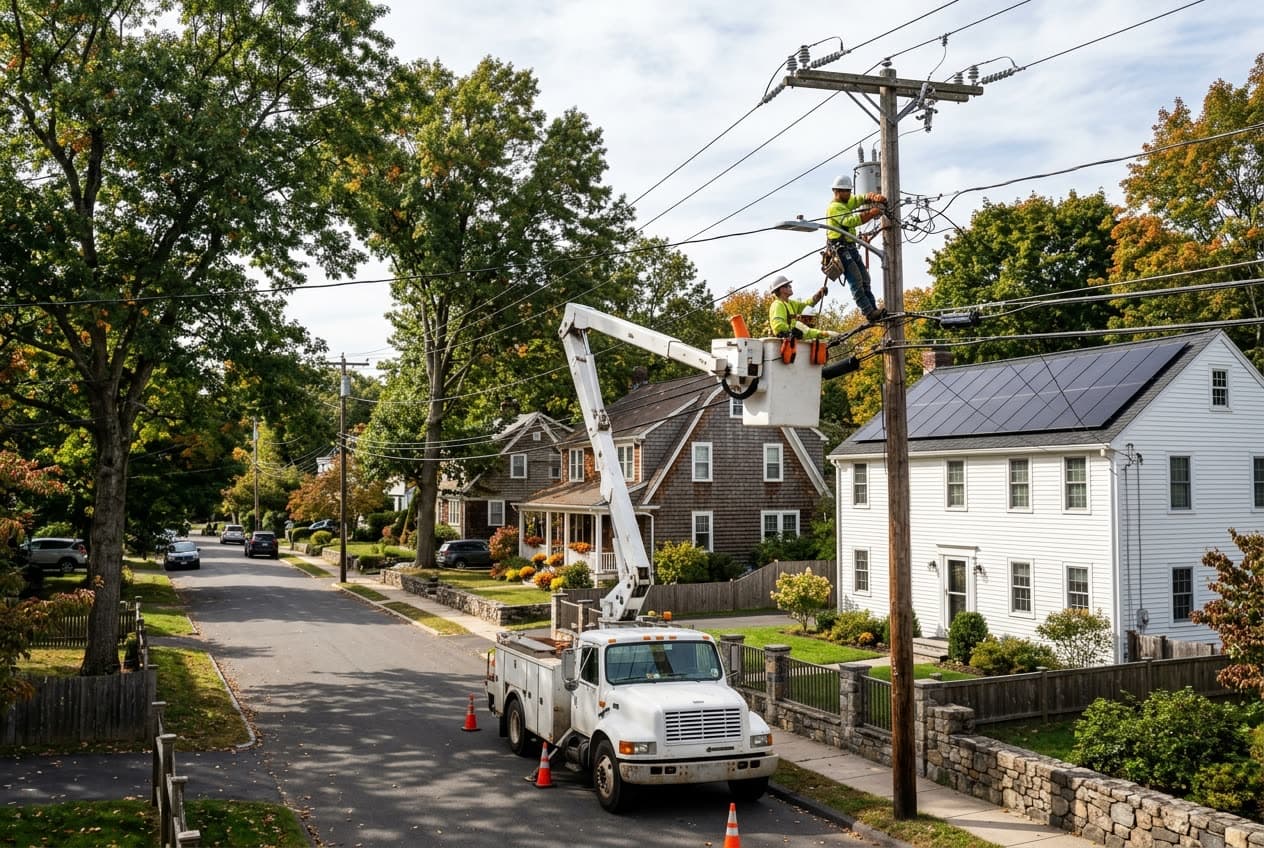
The new program uses active dispatch only. When the grid is under strain, the utility signals enrolled batteries to send stored power at the same time. Your home keeps running normally while it happens.
- Seasons. Summer runs June through September, and winter runs November through March. The program expects about 50 summer events and about 5 winter events a year.
- Timing. Events fall between 5 and 8 p.m. and usually last 2 to 3 hours.
- Notice. The utility usually gives about 24 hours' notice. Ask your installer or battery maker how you'll be told.
- Your choice. You can decide whether to join each event. Opting out lowers your average performance, and with it your payment.
The program also looks out for your backup power: events may be cancelled when severe storms are forecast. Performance payments arrive twice a year, at the end of each summer and winter season.
Homes that enrolled under the earlier rules could also be paid through a second track called passive dispatch. New enrollments from April 1, 2026 no longer use it, so your performance pay comes entirely from the active events above. That makes it worth keeping your battery online and connected to the internet, since a missed event counts against your average the same way an opt-out does.
Who qualifies, and how do you sign up?
To join as a homeowner, you need:
- An Eversource or UI electric account in Connecticut, with the battery installed at that address.
- An eligible contractor and approved battery equipment from the program's lists.
- A battery and installation that carry at least a 10-year warranty.
Solar isn't required, though a battery paired with solar can recharge from your panels during a long outage. Tell your contractor you want to join the program, and they handle the enrollment as part of your installation. Leases and other third-party-owned batteries can take part through the program's eligible third-party owners.
On warranties, batteries installed as part of an Evergreen Solar system are covered by the same 25-year warranty as the system, well past the program's 10-year minimum and its 10 years of performance payments.
How does it fit with RRES, loans and leases?
Energy Storage Solutions is separate from RRES, Connecticut's residential solar incentive. RRES pays for the power your panels produce, while Energy Storage Solutions pays for the battery. You can use both, and a battery doesn't count toward the RRES system size cap. Our guide to Connecticut's RRES solar program explains the Netting and Buy-All options.
There are several ways to pay for the battery itself:
- Smart-E Loan. The Connecticut Green Bank's loan covers solar panels and batteries for owner-occupied homes. Our guide to solar loan programs in Massachusetts and Connecticut has the current terms.
- A lease or PPA. A battery that's part of a lease or PPA can still qualify for the 30% federal credit, which lowers the rate or price you pay. Ask how the enrollment incentive and performance payments show up in your agreement.
- Cash. The 30% federal homeowner credit, which used to cover batteries, ended for systems installed after December 31, 2025. For cash and loan buyers, the program's upfront and 10-year payments now do much of that work.
For the bigger picture, see whether solar is worth it in Connecticut and our page on Connecticut solar incentives.
Frequently asked questions
What does Connecticut's Energy Storage Solutions program pay in 2026?
For homes that enroll on or after April 1, 2026, the program pays an upfront incentive of $30 per kWh of battery capacity, or $130 per kWh for Grid Edge customers. It also pays a performance incentive of $300 to $550 per kW-year for 10 years, depending on your customer class, as of October 2026.
Do I need solar panels to get the Connecticut battery incentive?
No. The program's homeowner FAQ says you don't need solar to install a battery and join. You do need an Eversource or UI electric account in Connecticut, with the battery at that same address. Pairing the battery with solar lets your panels recharge it during a long outage.
What happened to ConnectedSolutions in Connecticut?
Connecticut's ConnectedSolutions program stopped accepting new enrollments on December 2, 2023. Energy Storage Solutions is now the program for Connecticut homeowners who want to be paid for sharing battery power with the grid. Homes that enrolled in Energy Storage Solutions before April 1, 2026 stay on the earlier program rules.
Can I keep my battery for backup during a storm?
Usually. The program says events may be cancelled when severe storms are forecast, which helps keep your battery charged for backup. You can also choose whether to join each individual event, though opting out lowers your performance payment. Ask your installer how much charge your battery keeps in reserve.
Your next step
See what solar would do for your home
We design a system for your roof and show you the numbers for every way to pay. Free, with no pressure.
Get my free solar quoteKeep reading
How we wrote this
This page was written by the Evergreen Solar team, which designs and installs home solar across Massachusetts, Rhode Island, Connecticut, New Jersey and Pennsylvania. Program rules and rates change, so we check every figure against the primary source listed below and note the date we last did. If something has changed, tell us at our contact page.