Key takeaways
- Most solar systems can take a battery added later. An installer first checks your inverter, your main electrical panel and where the battery can go. Many homes with existing panels add an AC-coupled battery, which brings its own inverter and works alongside the one you already have, so the panels usually stay as they are.
- Adding a battery usually means a separate backed-up panel for the circuits you want to keep on in an outage, new wiring, a permit and an inspection. The utility generally needs to know about the change too, so your installer handles that paperwork along with the town's.
- Battery programs still apply when you add a battery to existing solar. Massachusetts ConnectedSolutions accepts batteries with new solar, existing solar or none, and Connecticut's Energy Storage Solutions doesn't require solar at all. Rhode Island's $5,000 grant bonus only applies when the battery is funded with the solar, so it rarely helps an add-on.
- If your solar is leased or under a PPA, the company that owns the system has to be part of the plan, since the battery connects to its equipment. If you own your system, check your solar warranty and the battery's warranty before work starts, so you know who covers what afterward.
Maybe the last storm left you in the dark while your panels sat idle on the roof. Or maybe you've heard that utilities now pay battery owners. Either way, you already have solar and you're wondering whether a battery can join it.
This article covers what decides whether your system can take a battery, what actually gets installed, the programs that still apply, and what to sort out if your system is leased. For the bigger question of whether a battery is worth it at all, start with our guide to solar batteries and backup power.
Can you add a battery to an existing solar system?
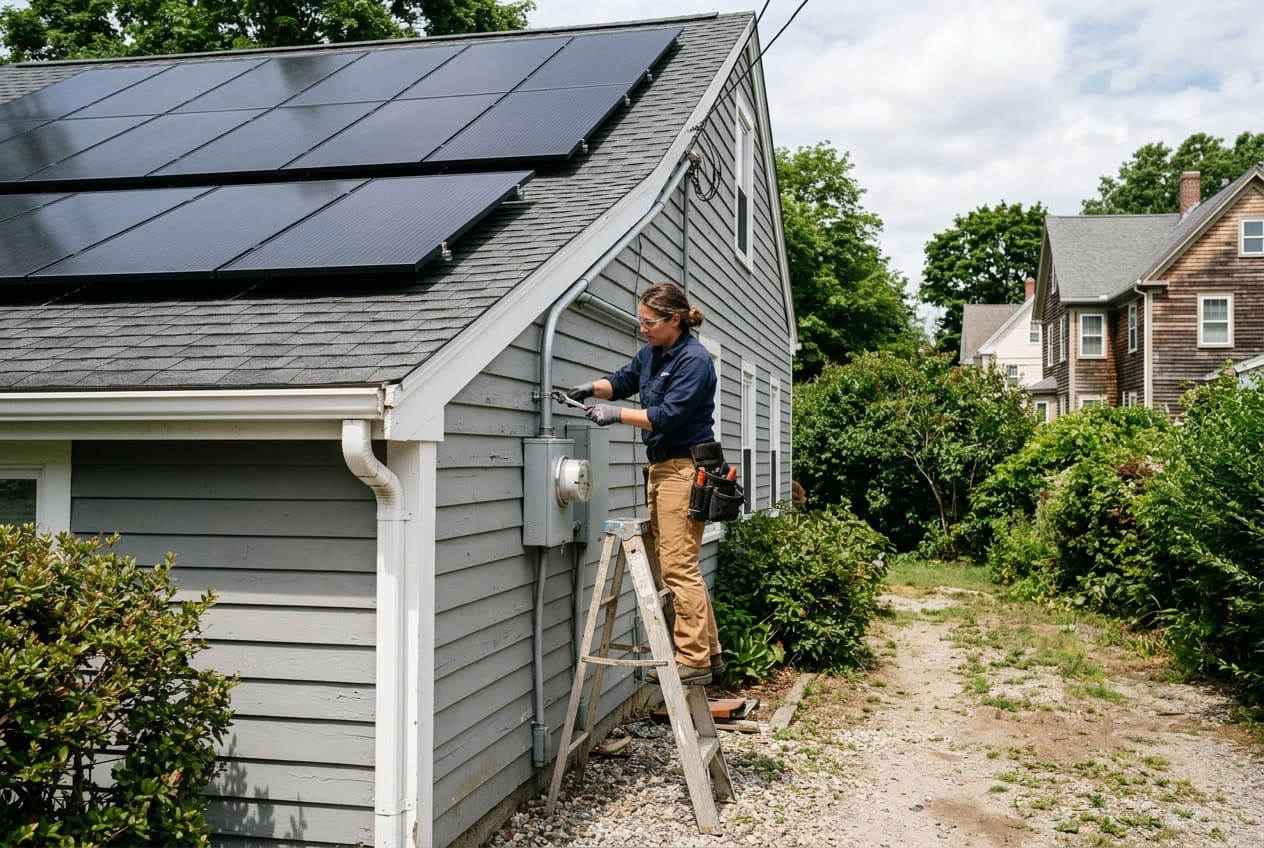
Usually, yes. Homeowners add batteries to solar systems that have been running for years, and most battery makers design for it. The panels on your roof normally stay exactly where they are.
Before anyone quotes a battery, an installer looks at four things:
- Your inverter. Its type, make and age decide how a battery connects. More on that below.
- Your main electrical panel. Whether it has room for the new connections, and whether it needs work first.
- Where the battery can go. Most home batteries mount on a wall in a garage or basement, or outside. The spot needs to meet the maker's rules and local code.
- What you want it to do. Backup for a few essentials, backup for the whole house, earning from a battery program, or all three.
Have your inverter's make and model handy, plus a recent electric bill. Both speed up the first conversation.
How does your inverter affect adding a battery?
Your panels make direct current (DC). Your home runs on alternating current (AC). The inverter converts one to the other, and our article on what a solar inverter does explains how. A battery has to connect to that chain somewhere, and there are two ways to do it.
- AC-coupled. The battery has its own inverter and connects on the AC side, alongside the inverter you already have. Battery makers describe it as working with your current grid-tied inverter, which is why it's the common choice for existing systems.
- DC-coupled. The panels and battery share one hybrid inverter that handles both. It's a tidy design for a new system, but adding one later usually means removing your current inverter and replacing it.
The kind of inverter you have matters too. If you have microinverters, each panel already converts its own power to AC on the roof, so an AC-coupled battery is the natural match. If you have a single string inverter on a wall, either approach can work, and an inverter nearing the end of its warranty may be a reason to consider a hybrid inverter instead. Our comparison of microinverters and string inverters shows how to tell which one you have.
One more thing to confirm: that your panels will keep recharging the battery during an outage. That's what turns a battery into multi-day backup, and not every existing setup does it without changes.
What gets installed when you add a battery?
Beyond the battery itself, expect a few changes around your electrical system:
- A backed-up loads panel. For essentials backup, the circuits you choose, such as the refrigerator, lights, Wi-Fi and furnace or boiler, move to a small separate panel the battery powers when the grid is down. Whole-home backup skips this but needs more battery.
- Equipment that disconnects from the grid. In an outage, the system separates your home from the utility lines, so crews working on them stay safe.
- Work on your main panel, if needed. An older or full panel may need changes first. Our article on electrical panel upgrades for solar covers what that involves.
The paperwork looks a lot like your original solar project. The town issues an electrical permit and inspects the work. The utility generally needs to approve the change to your system, too. Your installer files both, so you're mostly signing forms.
Which battery programs work with existing solar?
The good news for add-on batteries: the main programs care about the battery, not when your panels went up. Figures are as of October 2026.
- Massachusetts ConnectedSolutions. Mass Save pays $275 per kW of the battery's average contribution during summer peak events. Batteries qualify with new solar, existing solar or no solar. It's open to Eversource, National Grid and Cape Light Compact customers.
- Connecticut Energy Storage Solutions. Solar isn't required. New enrollments since April 1, 2026 get an upfront incentive of $30 per kWh of capacity ($130 per kWh on the most outage-prone circuits), plus performance payments for 10 years. Eversource and UI customers qualify.
- Rhode Island. Rhode Island Energy runs its own ConnectedSolutions battery program, so ask your installer for the current terms. The state's Renewable Energy Fund grant adds $5,000 for a battery, but only when it's funded in the same award as the solar. A battery added to panels you already own generally doesn't qualify. Our Rhode Island solar grant article has the details.
During program events, the battery sends some of its stored power to the grid. Ask your installer how the battery is set up during events and what that means for backup on those days.
How can you pay for an add-on battery?
Two state-backed loans cover batteries on their own, which suits a battery added after the solar:
- Mass Save HEAT Loan (Massachusetts). 0% financing up to $25,000 for a battery enrolled in ConnectedSolutions, as of October 2026. Applying for it means agreeing to enroll.
- Smart-E Loan (Connecticut). The Connecticut Green Bank's loan covers batteries as well as solar panels.
Our guide to solar loan programs in Massachusetts and Connecticut compares both. If you're paying cash or with a loan, note that the 30% federal homeowner credit ended for batteries installed after December 31, 2025, so the state programs above now carry most of the value.
What if your solar is leased or under a PPA?
Then the panels and inverter belong to the company you signed with, and the battery would connect to its equipment. The system owner has to be part of the plan. Read your contract for rules on changes to the system, and call the owner before you sign anything for a battery.
Some companies offer a battery under their own agreement. Our article on how the tax credit works with a lease explains why a battery that's part of a lease or PPA can still qualify for the 30% federal credit, which lowers what you pay.
What happens to your warranties?
You'll have at least two warranties to keep straight:
- Your existing solar warranty. Check what it says about changes to the system or work by another company, and whether your inverter maker requires certain equipment.
- The battery's warranty. Note how long it lasts and any limits it sets on use. In Connecticut, Energy Storage Solutions requires at least a 10-year warranty on the battery and the installation.
Batteries installed as part of an Evergreen Solar system are covered by the same 25-year warranty as the system, so the battery and the panels are protected for the same stretch. If another company installed your panels, ask how the new battery's coverage and your existing warranty fit together.
Comparing more than one offer? Our article on how to compare solar quotes lists what each one should spell out. Questions about your own system? Call us at (508) 507-2908.
Frequently asked questions
Do I need a new inverter to add a battery to my solar panels?
Usually not. An AC-coupled battery comes with its own inverter and works alongside the inverter you already have, which is why it's the common choice for existing systems. A DC-coupled battery shares one hybrid inverter with the panels, so adding one later usually means replacing your current inverter. Your installer tells you which fits your system.
Will my solar panels charge the battery during a power outage?
With a system designed for backup, yes. When the grid goes down, the battery system separates your home from the grid and the panels recharge the battery during the day. Not every existing setup works this way without changes, so ask your installer to confirm that your panels will keep charging the battery in an outage.
Can I get the 30% tax credit for adding a battery to my solar?
Not as a homeowner paying cash or using a loan. The 30% federal homeowner credit ended for batteries installed after December 31, 2025. A battery that's part of a lease or PPA can still qualify for the 30% federal credit, which lowers what you pay. State programs such as ConnectedSolutions and Energy Storage Solutions also help.
Does adding a battery void my solar panel warranty?
It shouldn't if the work is done properly, but the answer depends on your warranty's terms. Read the section on changes to the system, and ask whether the installer adding the battery needs to be approved by your panel or inverter maker. If your solar is leased or under a PPA, get the system owner's approval first.
Your next step
See what solar would do for your home
We design a system for your roof and show you the numbers for every way to pay. Free, with no pressure.
Get my free solar quoteKeep reading
How we wrote this
This page was written by the Evergreen Solar team, which designs and installs home solar across Massachusetts, Rhode Island, Connecticut, New Jersey and Pennsylvania. Program rules and rates change, so we check every figure against the primary source listed below and note the date we last did. If something has changed, tell us at our contact page.
Sources
- Mass Save: Battery storage and ConnectedSolutions
- Energy Storage Solutions (Connecticut): Homeowner FAQ
- Commerce RI: Renewable Energy Fund small-scale solar RFP (rev. April 6, 2026)
- U.S. Department of Energy: Solar-Plus-Storage 101
- Cape Light Compact: Mass Save HEAT Loan
- Enphase: AC-coupled vs. DC-coupled batteries (Feb. 17, 2020)