Key takeaways
- Most homes don't need an electrical panel upgrade for solar. Your system connects to the main panel, usually through a breaker, so the installer checks the panel's rating, condition and open space during the site survey. Older or smaller panels are the ones that sometimes need an upgrade or a different type of connection.
- The National Electrical Code limits how much power can feed a panel's busbar. Under the common 120% rule, the main breaker plus 125% of the solar output can't exceed 120% of the busbar rating. A typical 200-amp panel with a 200-amp main can take up to a 40-amp solar breaker this way.
- If your panel can't take a solar breaker, an upgrade isn't the only answer. Installers can sometimes connect on the supply side, between the meter and the main breaker, which doesn't add to the busbar. Which option fits depends on your equipment, local code and your utility's rules.
- If you're planning an electric car charger, a heat pump or other new electric loads, say so before your system is designed. They add load to the same panel, and planning for them now can avoid a second round of electrical work. Any electrical work should be in your quote before you sign.
You found a solar company, the roof looks good, and then someone mentions your electrical panel. It's a common moment in a solar project, and it can stall a decision if nobody explains it clearly.
Here's the plain version: how solar connects to your panel, why some homes need an upgrade, and what to ask so there are no surprises. For the rest of what makes a home ready, see our guide to solar and your roof.
How does solar connect to your electrical panel?
Solar panels make direct current (DC) power. Inverters, either one central unit or small microinverters under each panel, change it to the alternating current (AC) your home uses. That AC power has to join your home's wiring somewhere, and that somewhere is the main electrical panel or the service right next to it.
There are two common ways to make that connection:
- A breaker in the panel (load-side connection). The solar system gets its own breaker, just like a circuit for your kitchen or dryer. Power flows backward through that breaker into the panel, which is why installers call it a backfed breaker. This is the most common setup.
- A tap before the main breaker (supply-side connection). The solar system connects between the utility meter and your main breaker, with its own disconnect and protection. The power never passes through the panel's busbar, so the panel's limits matter less.
Either way, the goal is the same: your home uses solar power first, and any extra flows out to the grid through your meter. Our guide to how home solar works covers that path from panel to meter.
Why do some homes need a panel upgrade for solar?
Most homes connect solar to the panel they already have. An upgrade comes up when the panel can't safely or legally take the new connection. The usual reasons:
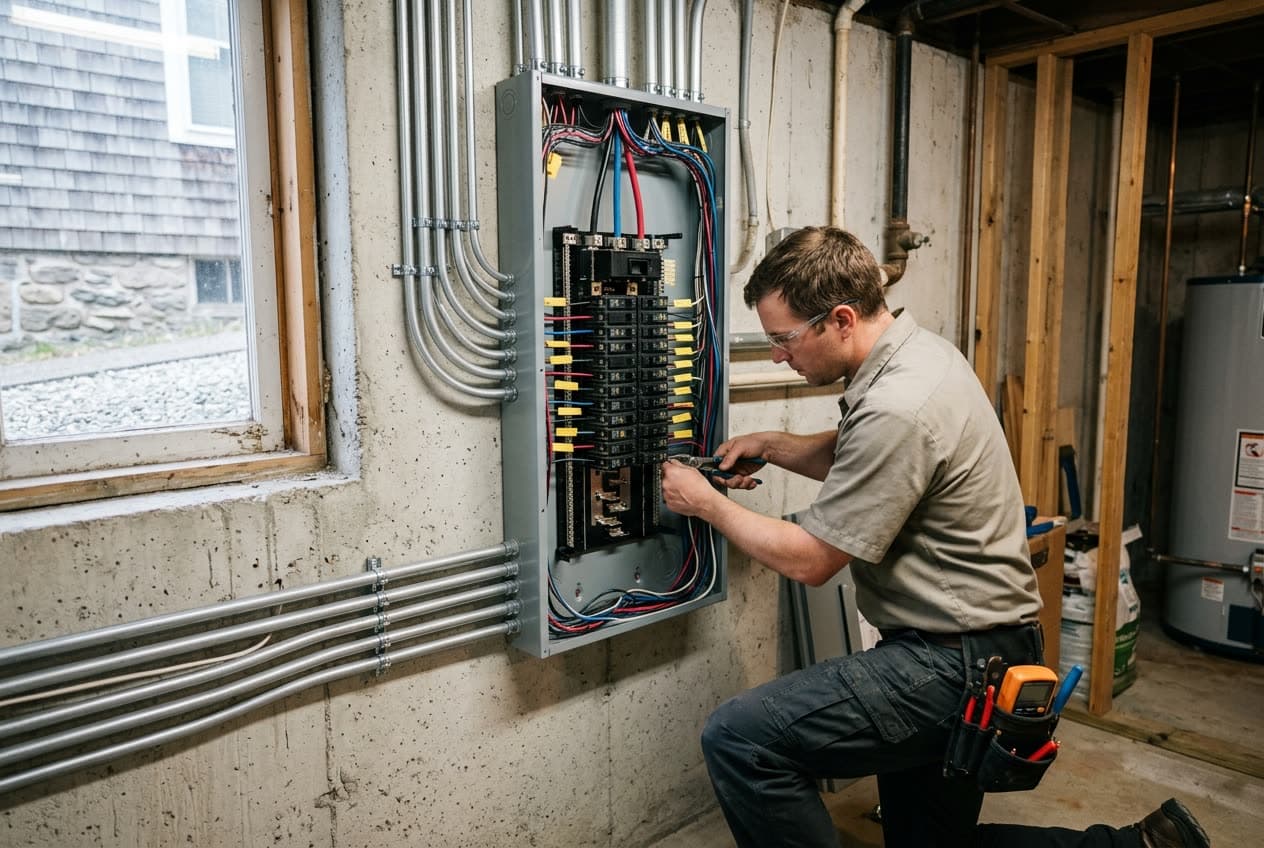
- The busbar rating is too low. The busbar is the metal strip inside the panel that the breakers clip onto. It has an amp rating, and adding solar power to it is limited by code (more on that below). A smaller panel, such as a 100-amp panel in an older home, has less room.
- There's no space. A panel with every slot full may not have room for a solar breaker.
- The panel is old or in poor shape. A fuse box, a panel with damage or corrosion, or one with wiring that doesn't meet today's code may need replacing before an inspector will sign off on new work.
- The system is large. A bigger system means a bigger solar breaker, which is more likely to run into the panel's limits.
An upgrade isn't the only fix. Depending on the equipment, an installer may use a supply-side connection, adjust the system design, or both.
What is the 120% rule for solar?
The National Electrical Code (NEC), published by the NFPA and adopted by each state with its own changes, sets the rules for connecting solar to a home. Section 705.12 covers load-side connections, the kind that use a breaker in your panel.
The rule most homeowners hear about is the 120% rule. The busbar has to handle current from two directions: the grid through your main breaker, and solar through its breaker. The code lets the two add up to a bit more than the busbar's rating, but only up to 120% of it, and only when the solar breaker sits at the opposite end of the busbar from the main breaker so the currents don't pile up in one spot.
The 120% rule, in numbers
The main breaker rating plus 125% of the solar system's output current can't be more than 120% of the busbar rating. California's statewide solar permitting guidebook shows what that means: a 200-amp busbar with a 200-amp main breaker can take up to a 40-amp solar breaker, and a 100-amp busbar with a 100-amp main can take only 20 amps. If the solar breaker can't sit at the opposite end, the limit drops to 100% of the busbar, leaving no room at all in either example.
The exact wording and section numbers change between code editions, and your town's inspector enforces the edition your state has adopted. Your installer works out the math for your panel. You don't need to do it yourself, but knowing the rule helps you understand why two homes with the same size system can get different answers.
Should you plan for an EV charger or heat pump now?
Yes, if they're on your list. A Level 2 car charger and a heat pump both draw a lot of power, and both connect to the same panel your solar system will use. A panel that has room for solar today may not have room for solar plus a charger next year.
Planning them together has two benefits. The installer can size the solar system for the electricity you'll actually use, not just your past bills. And if the panel needs work, it can be done once, with one permit and one inspection, instead of twice.
It also works the other way. If you're adding a battery for backup power, that changes the connection design too. Our guide to solar batteries and backup power covers what a battery adds, and our post on solar in an all-electric home looks at the bigger picture.
How does an installer check your electrical panel?
The panel check happens during the site survey, the in-person visit after you sign up and before the final design. At Evergreen Solar, the survey covers your roof, your attic and your home's electrical system.
On the electrical side, a surveyor typically looks at:
- The main breaker and busbar ratings, from the panel label
- How many open slots are left, and where they are
- The panel's age, brand and condition
- Where the meter is and how the service comes into the house
- Where new equipment like a disconnect or a battery could go
Those notes go to the design team, which picks the connection method and flags any upgrade. Our article on what happens at a solar consultation and site visit explains each step. A clear photo of your open panel and its label, shared early, can speed things up.
| Connection | How it works | When it's used |
|---|---|---|
| Breaker in the panel | Solar gets its own breaker on the busbar | Most homes, when the panel passes the 120% rule and has space |
| Supply-side tap | Connects between the meter and the main breaker, with its own disconnect | When the busbar is too small, if your town and utility allow it |
| Panel upgrade | The main panel is replaced with one that has a higher rating or more space | When the panel is full, old, damaged, or too small for current and future loads |
Who does the work, and how should it appear in your quote?
Electrical work for solar is done by licensed electricians and inspected by your town. The Department of Energy notes that a qualified installer builds the system to meet local building, fire and electrical codes. At Evergreen Solar, our team files the permit applications with your town and your utility as part of every project.
If the electrical service coming into your house needs to get bigger, the utility has to be part of that work too, since it controls the wires and the meter. That can add a step to the schedule, so it's better to know at the start.
Most important: any electrical work your home needs should be in your quote before you sign, not added afterward. When you're comparing solar quotes, ask each company:
- Did you check my panel in person, or from photos?
- How will the system connect, and does my panel pass the code limits?
- Is any panel or service upgrade included in this price?
- Did you plan for the EV charger or heat pump I mentioned?
Questions about your own panel? Call us at (508) 507-2908. We'll look at what you have and tell you plainly whether it's ready for solar.
Frequently asked questions
Do I need a new electrical panel for solar?
Usually not. Most homes can connect solar to the panel they already have. A new panel is sometimes needed when the existing one is small, full, damaged or too old to accept a solar breaker, or when the system is too large for the panel's busbar rating. Your installer checks this during the site survey.
Can a 100-amp panel handle solar?
Sometimes, but it is tight. Under the 120% rule, a 100-amp panel with a 100-amp main breaker leaves room for only a small solar breaker, which may limit the system size. Installers can sometimes use a supply-side connection instead, and some homes upgrade the panel, especially if an EV charger or heat pump is also planned.
What is a supply-side connection for solar?
It connects the solar system between the utility meter and your main breaker, instead of through a breaker inside the panel. Because the solar power doesn't pass through the panel's busbar, the 120% rule doesn't limit it. It needs its own disconnect and protection, and the installer confirms it is allowed by your town and utility.
Who pulls the electrical permit for a solar panel upgrade?
Usually the installer. The solar permit and any electrical permit for panel work are filed with your town, and the work is done by licensed electricians and checked by the local inspector. If your electrical service has to get bigger, the utility is involved as well. Ask who handles each step before you sign.
Your next step
Get a solar and roof assessment
We check your roof's condition, design your system, and price solar with or without a new roof. Free, with no pressure.
Get my roof + solar quoteKeep reading
How we wrote this
This page was written by the Evergreen Solar team, which designs and installs home solar across Massachusetts, Rhode Island, Connecticut, New Jersey and Pennsylvania. Program rules and rates change, so we check every figure against the primary source listed below and note the date we last did. If something has changed, tell us at our contact page.
Sources
- California Governor's Office of Planning and Research: California Solar Permitting Guidebook, 4th Edition (2019)
- NFPA 70, National Electrical Code (Article 705, interconnected power sources)
- U.S. Department of Energy: Homeowner's Guide to Going Solar
- U.S. Department of Energy: Walk Me Through It, A Step-by-Step Guide for Consumers Going Solar