Key takeaways
- Yes, you can put solar panels on a metal roof, and it is often one of the best roofs for them. A well-installed metal roof lasts a long time, so it is unlikely to need replacing during the life of the panels. Evergreen Solar installs on standing-seam and other metal roofs.
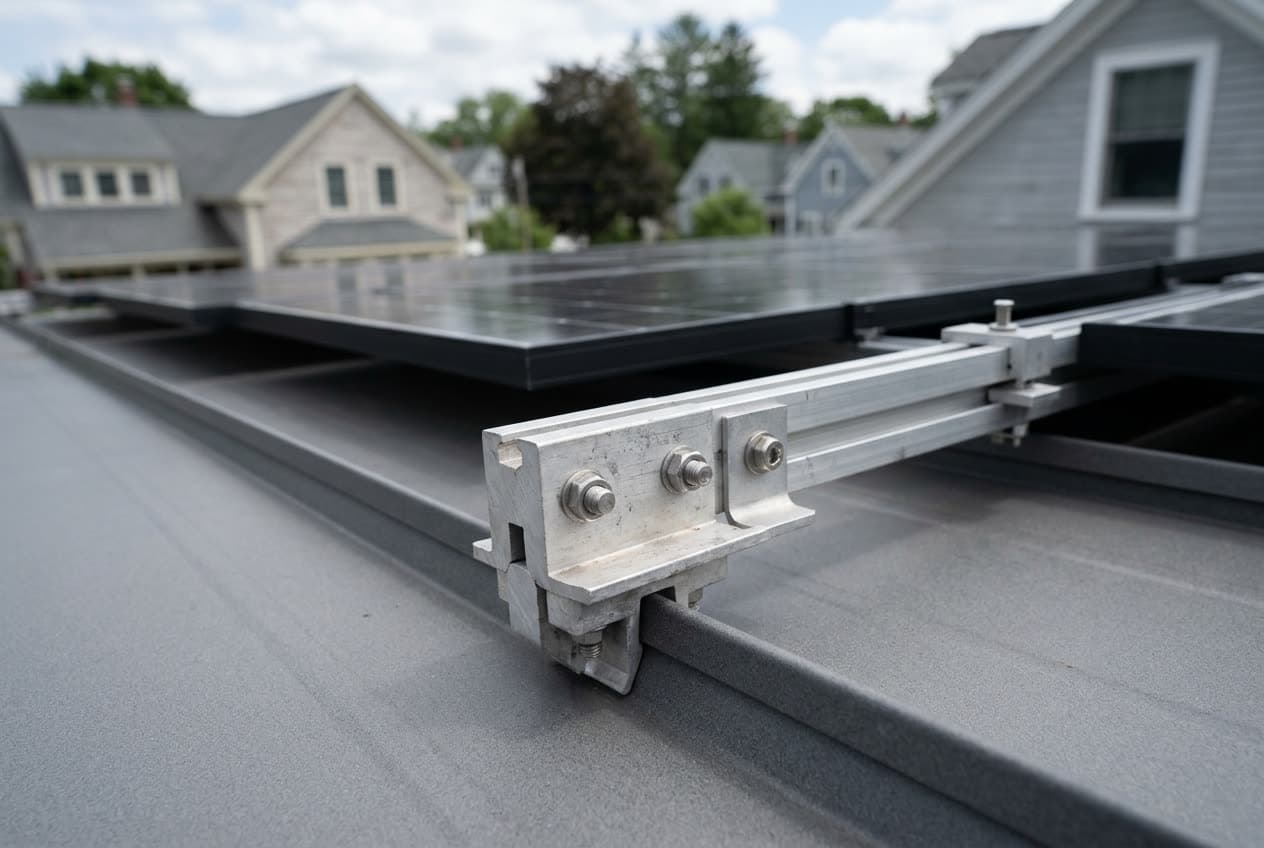
- On a standing-seam metal roof, clamps grip the raised seams with setscrews that press into the metal without piercing it. The racking or panels attach to those clamps, so the system usually needs no holes through the roof. The clamps must be made for your seam profile.
- On corrugated or other exposed-fastener metal roofs, the mounts are shaped for the panel profile and fasten through the metal into the structure underneath, such as the wood deck or purlins. Each attachment is sealed so water runs past it, the same standard that applies to any roof penetration.
- Snow slides off metal roofs and solar panels more readily than off shingles, and it can come down all at once. If the array sits above a door, walkway or driveway, ask your installer about snow guards, which help hold snow in place so it melts off more slowly.
Metal roofs are common across New England, on homes, additions, porches and barns. If you have one, you may have heard that solar is harder to install on metal, or that it means drilling holes in a roof you paid good money for.
In most cases, the opposite is true. This article explains how solar attaches to the main kinds of metal roofs, what your installer checks first and what to ask. For roof age, direction and shade, start with our guide to solar and your roof.
Can you put solar panels on a metal roof?
Yes. A metal roof is often one of the best roofs for solar panels, for two reasons.
- It lasts. The Metal Construction Association describes standing-seam metal as a roof that can serve for five to ten decades. NREL's planning guide for solar-ready buildings advises putting panels on a roof that will last at least as long as they do. A sound metal roof usually clears that bar with room to spare.
- It can often carry panels without holes. On standing-seam metal, the mounting hardware grips the roof instead of going through it. NREL calls standing seam "often the best option" for a building that may add solar later.
Evergreen Solar installs on standing-seam and other metal roofs, as well as asphalt shingle and flat roofs. How the panels attach depends on which kind of metal roof you have.
How do solar panels attach to a standing-seam metal roof?
A standing-seam roof is made of long metal panels joined by raised ribs, or seams, that run from the ridge down to the eave. Those seams are what make it so easy to work with.
Small clamps fit over the seams and tighten with setscrews. The Metal Construction Association explains that the best clamps use round-tipped setscrews that press a small dent into the seam without piercing it. That dent locks the clamp in place. The solar racking, or the panels themselves, then attach to the clamps.
This approach has a few real advantages:
- No holes through the roof. Water has no new path in, because the roof surface stays whole.
- The roof can still move. Metal expands and contracts with heat and cold. Fastening through a standing-seam panel can pin it in place and stress it over time. Clamps let the roof move as it was designed to.
- A strong hold. The seam acts like a small beam. Clamps tested on a given seam shape and metal thickness have published holding strengths, and the design keeps the load within them.
The catch is fit. Standing seams come in many shapes, such as snap-lock, mechanically folded and T-shaped seams. Clamps are made for specific profiles, so the installer has to match the clamp to your roof.
What about corrugated and exposed-fastener metal roofs?
Many metal roofs don't have raised seams. Corrugated metal has rounded waves, and ribbed panels have flat-topped ribs held down by screws you can see on the surface. These are called exposed-fastener roofs, and they're common on barns, garages, sheds and some newer homes.
Solar works on these roofs too, with a different kind of mount. The brackets are shaped to sit on the roof's profile, and they fasten through the metal into the structure underneath, such as the wood deck, rafters or purlins. Fastening into the metal sheet alone isn't enough to hold an array in wind and snow.
Because these mounts do go through the roof, sealing is the key step. NREL's guidance for any roof penetration is to use flashing or flashed mounts and proper sealing so the attachment doesn't cause a leak. The goal is for water to run past each bracket instead of following the screw into the roof. Ask your installer how the mounts on your roof will be sealed, and whether the brackets come with a gasket or sealant built into the base.
What does an installer check on a metal roof?
The site survey looks at every roof, but a metal roof gets a few extra checks:
- The profile. The seam or rib shape decides which clamp or bracket fits. A mismatched clamp won't hold the way it was tested to.
- The metal's thickness and type. Holding strength depends on the metal's gauge, or thickness, as well as the seam. Steel, aluminum and copper roofs each need compatible hardware, since some metals corrode when they touch.
- How the roof is attached to the house. Any load on the clamps passes into the roof panels and then into the structure. NREL notes that a standing-seam roof must be attached well enough to carry the added load of an array.
- What's underneath. On exposed-fastener roofs, the installer locates the deck, rafters or purlins the mounts will fasten into.
- Grounding and bonding. The National Electrical Code covers how the metal parts of a solar array are bonded and grounded, and the racking parts that do this are tested and listed under a standard called UL 2703.
- Your roof warranty. NREL points out that some roof warranties require a certain style of mount or flashing. Your roofing manufacturer can tell you which attachments it approves.
Does snow slide off a metal roof with solar panels?
Yes, and more readily than off shingles. Smooth metal and smooth panel glass both shed snow well. That is good for production, because the panels clear sooner after a storm. It also means snow can come off the roof all at once.
A sheet of wet snow sliding off a roof edge can land hard on a walkway, a deck, a car or a person. If the array will sit above a door, a path or a driveway, ask your installer about snow guards. These brackets or bars on the roof help hold sliding snow in place so it melts off more slowly. On standing-seam roofs they often attach with seam clamps too, without holes through the roof.
Our article on solar panels and snow covers the rest of winter, including why you usually don't need to clear your panels at all.
What should you ask before going solar on a metal roof?
Bring these questions to any installer you're considering:
- Have you installed on my type of metal roof before, and what mounting hardware will you use?
- Will any part of the installation go through the roof? If so, how will each attachment be sealed?
- Is the clamp or bracket made and tested for my roof's profile and metal?
- Does the plan follow my roof warranty's terms?
- Do I need snow guards over doors, walkways or the driveway?
- What does your warranty cover if something goes wrong with the installation?
Every Evergreen Solar package includes a 25-year comprehensive solar warranty and a 25-year power production guarantee. If your roof isn't a good match for solar, we'll say so. Our post on whether your roof is good for solar covers the general checks for every roof type.
Have a metal roof and want to know what solar would look like on it? Call us at (508) 507-2908, and we'll walk you through how the panels would attach to your roof.
Frequently asked questions
Do solar panels on a metal roof need holes drilled in the roof?
On a standing-seam roof, usually not. Clamps grip the raised seams with setscrews that dent the metal without piercing it, and the solar racking attaches to the clamps. Corrugated and other exposed-fastener metal roofs are different: the mounts fasten through the metal into the structure underneath, and each attachment is sealed against water.
Will solar panels void my metal roof warranty?
Not when the installation follows the roof warranty's terms. Some roof warranties require a certain style of mount or flashing, so ask your installer to check yours during the design. Clamps that grip the seam without piercing it are one reason standing-seam roofs work so well with solar. Your roofing manufacturer can confirm which attachments it approves.
Is a metal roof better than shingles for solar panels?
Both work well. A standing-seam metal roof has two advantages: it lasts a long time, and the panels can often attach without any holes through the roof. Asphalt shingle is the most common roof for solar and the simplest to plan around. The condition of your roof matters more than the material.
Can solar panels go on a copper or other specialty metal roof?
Sometimes, with the right hardware. Seam clamps are usually aluminum with stainless steel bolts, which suit most metal roofs. Copper reacts with some other metals and can corrode them, so copper roofs call for clamps made from a compatible metal, such as brass. Your installer will confirm the right parts for your roof before the design is final.
Your next step
Get a solar and roof assessment
We check your roof's condition, design your system, and price solar with or without a new roof. Free, with no pressure.
Get my roof + solar quoteKeep reading
How we wrote this
This page was written by the Evergreen Solar team, which designs and installs home solar across Massachusetts, Rhode Island, Connecticut, New Jersey and Pennsylvania. Program rules and rates change, so we check every figure against the primary source listed below and note the date we last did. If something has changed, tell us at our contact page.
Sources
- NREL: Solar Ready Buildings Planning Guide (NREL/TP-7A2-46078, December 2009)
- U.S. Department of Energy: Homeowner's Guide to Going Solar
- Metal Construction Association: Metal Roofing from A to Z, Part 7, Rooftop Equipment Mounting and Penetrations (2014)
- IAEI Magazine: Bonding and Grounding PV Systems (May/June 2015)