Key takeaways
- Yes, solar panels work on flat and low-slope roofs, including the triple-deckers, two-families and additions common in Boston, Worcester and the cities around Providence. Racking tilts the panels toward the sun, so a flat roof can produce well. Evergreen Solar installs on flat and low-slope roofs.
- Flat-roof racking is held in place in one of two ways. Ballasted racking sits on the roof and is held down by weight, so it avoids holes but adds load. Attached racking fastens into the structure, with every attachment flashed and sealed. Either way, the installer checks how much weight your roof can carry.
- Check the roof covering before solar goes on. NREL advises installing panels on a roof that will last at least as long as they do, and taking panels off later to redo the roof adds cost. If your flat roof is near the end of its life, have it redone first.
- A flat-roof system earns the same incentives as any other home system. In Massachusetts, SMART 3.0 pays a flat $0.03 per kWh for program year 2026 on systems of 25 kW AC or less, for up to 20 years, on top of net metering credits.
Walk any street in Dorchester, Somerville or Worcester and you'll see them: triple-deckers and two-families with flat or nearly flat roofs, plus plenty of flat-roofed additions and porches. The same goes for Providence and Pawtucket across the line.
If that describes your home, solar is still on the table. This article covers how panels go on a flat roof, what your roof needs, and how incentives work. For direction, shade and roof age in general, start with our guide to solar and your roof.
Can you put solar panels on a flat roof?
Yes. A flat roof doesn't limit which way the panels face, because the racking sets the direction and angle. That often means the panels can point toward the sun better than they could on a sloped roof that faces east or west.
Flat roofs on city homes also tend to have fewer vents, dormers and chimneys in the way, so the open area can be put to good use. The usual limits are shade from taller neighbors and how much weight the roof can carry. Evergreen Solar installs on flat and low-slope roofs, as well as asphalt shingle and metal roofs.
A flat roof doesn't have to carry the whole system, either. Many homes pair a sloped main roof with a flat-roofed addition, porch or garage. In that case, the design can put panels on both, as long as each section gets enough sun and can carry the weight. The site survey looks at every roof surface, not just the biggest one.
How are solar panels mounted on a flat roof?
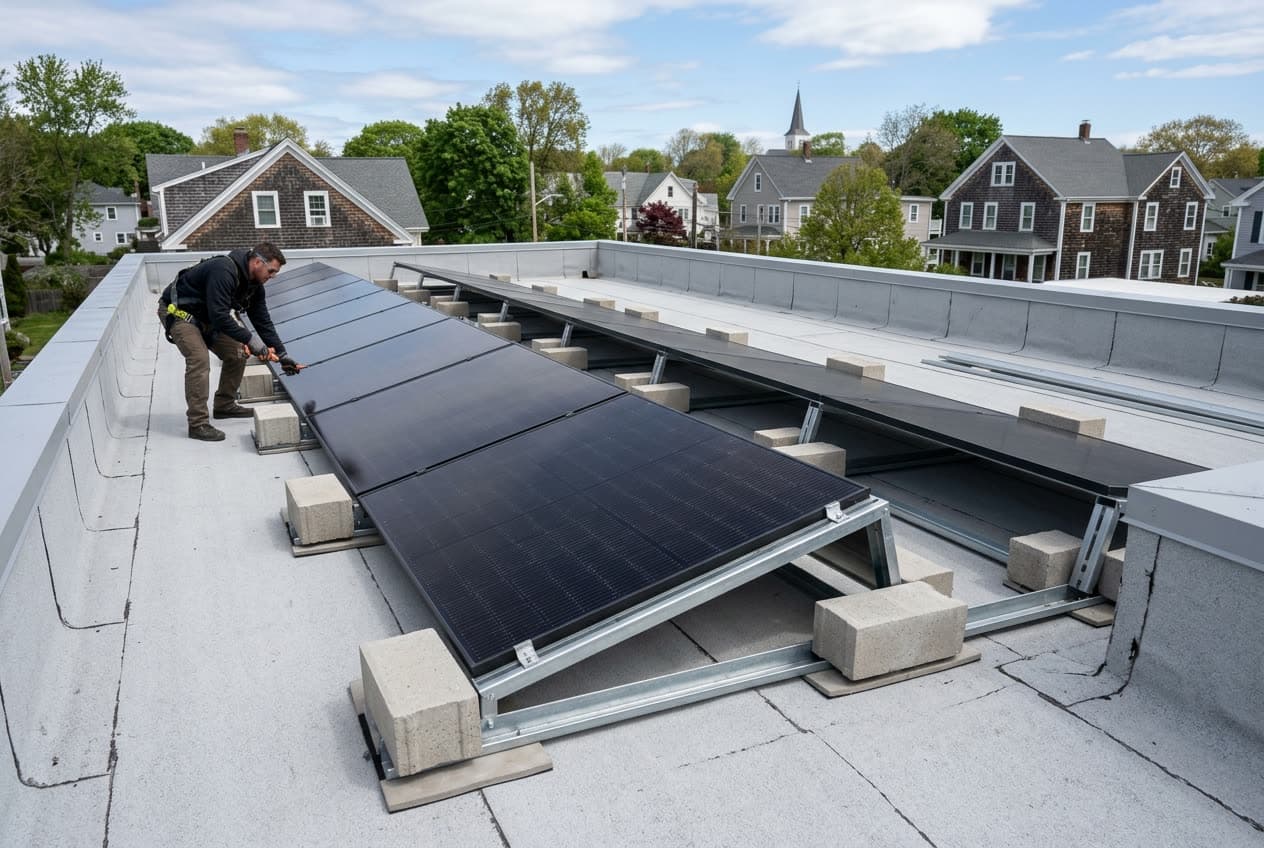
Flat-roof racking tilts the panels up and holds them in place in one of two ways.
- Ballasted racking sits on top of the roof and is held down by weight, such as concrete blocks set into the racking. NREL notes that these systems avoid roof penetrations, but they add significant weight to the roof.
- Attached racking fastens through the roof into the structure. It weighs less, but each attachment is a penetration. NREL's guidance is to flash and seal every one so it doesn't cause a leak.
Some systems combine the two, with a few attachments and less ballast. The choice depends on your roof's structure, the roof covering and the wind and snow loads where you live.
Weight is the big question. NREL's planning guide puts typical panels and racking at about 3 pounds per square foot of panel area, and ballasted systems at roughly 4 to 6. That's why the installer checks the roof framing before choosing a racking type. Older homes vary a lot, and the design has to fit the roof you actually have.
How much tilt and spacing do flat-roof panels need?
On a flat roof, the designer chooses the tilt. A steeper angle can capture more sun in winter and helps rain and snow slide off. But tilted rows cast shadows behind them, so steeper rows need wider gaps between them.
That creates a trade-off. Lower tilt fits more rows on the same roof. Higher tilt gets more from each panel but fits fewer. NREL notes that larger arrays space their rows so each row gets full sun at 10 a.m. on the winter solstice, when shadows are longest. On a small city roof, the designer balances tilt, row spacing and the space you need to keep clear around the edges.
The production estimate is built from historical weather data for your address, so it reflects the tilt and spacing your roof allows.
Is your flat roof ready for solar?
Flat roofs are usually covered by a membrane, such as rubber (EPDM), TPO or PVC, or by a built-up or modified bitumen roof. NREL notes that membrane roofs can work well with solar. It also flags roofs covered in loose river rock, because the stone has to be moved before panels go on.
Age and condition matter most. NREL advises putting panels on a roof that will last at least as long as they do, and points out that panels may have to come off if the roof is resurfaced later. If your flat roof is worn, patched or near the end of its life, have it redone before solar goes on.
Evergreen Solar's solar + roof program uses CertainTeed shingles on sloped roofs, so if your flat roof needs work, ask us how it would be handled for your home. If your home has a sloped section too, our article on the roof and solar package explains how the program works for the shingled part.
How do drainage and snow work with flat-roof solar?
Water has to leave a flat roof through drains, scuppers or gutters. The racking layout keeps those clear and leaves room for water to flow under and around the array. Where the racking rests on the roof, the installer protects the roof covering so the racking doesn't wear through it over time.
Snow behaves differently on a flat roof, too. Panels at a low tilt hold snow longer than steeper ones, and the roof itself can collect drifts around the array. Local building codes set the snow load a roof must carry, and the structural check covers the panels plus the snow. Our article on solar panels and snow explains why you rarely need to clear them.
What about triple-deckers, two-families and condos?
On a home with more than one unit, the roof is the easy part. The questions to settle first are about ownership and accounts:
- Who owns the roof? If you own the whole building, the decision is yours. In a condo, the roof may be shared property, so check with your association before you sign anything.
- Which electric account does the system serve? Many two- and three-family homes have a separate meter for each unit. Decide up front whose account the system connects to and who receives the bill credits.
- How big should it be? The system is sized to the usage on the account it serves.
Bring these questions to your consultation, along with a recent bill for each account you're considering.
Do flat-roof solar systems get the same incentives?
Yes. A flat roof doesn't change the incentives. In Massachusetts, as of October 2026:
- SMART 3.0 pays a flat $0.03 per kWh for program year 2026 ($0.06 for low-income customers) on systems of 25 kW AC or less, for up to 20 years. It's open to Eversource, National Grid and Unitil customers.
- Net metering credits extra power on top of SMART, and small systems keep full-value credits that roll over.
- Homeowners who buy their system can claim a state income tax credit of 15% of the net cost, up to $1,000.
Leases and PPAs work on flat roofs too. Because the system qualifies for the 30% federal credit, you get a lower rate, which is often a better deal than buying. Rhode Island and Connecticut homeowners can see their programs on our Rhode Island and Connecticut incentive pages, and the full Massachusetts list is on our Massachusetts incentives page.
Have a flat roof and want to know what it could hold? Call us at (508) 507-2908, and we'll show you a layout for your roof.
Frequently asked questions
Do solar panels on a flat roof need to be tilted?
Usually, yes. Racking tilts the panels toward the sun so they produce more and shed rain, dirt and some snow. The angle is a trade-off: steeper rows need more space between them so they don't shade each other, which can mean fewer panels on a small roof. The design picks the tilt that makes the most of your roof.
Will solar panels make my flat roof leak?
A proper installation shouldn't. Ballasted racking rests on the roof and is held down by weight, so it avoids holes through the roof. Attached racking fastens into the structure, and every attachment is flashed and sealed. Either way, the installer protects the roof covering, keeps drains clear and checks the roof's condition before any work starts.
Can I put solar on a triple-decker in Boston?
Often, yes. Many triple-deckers have flat or low-slope roofs with few obstructions, which suits tilted racking. The installer checks the roof's structure and condition, shade from nearby buildings and the electrical setup. If the building has more than one owner or more than one electric account, settle who owns the system and who gets the credits before you sign.
Should I replace my flat roof before installing solar?
If the roof covering is worn or near the end of its life, yes. Panels stay on the roof for decades, and taking them off later to redo the roof adds cost and downtime. A roof in good condition can go straight to solar. Your installer will look at the roof during the site survey and tell you which applies.
Your next step
Get a solar and roof assessment
We check your roof's condition, design your system, and price solar with or without a new roof. Free, with no pressure.
Get my roof + solar quoteKeep reading
How we wrote this
This page was written by the Evergreen Solar team, which designs and installs home solar across Massachusetts, Rhode Island, Connecticut, New Jersey and Pennsylvania. Program rules and rates change, so we check every figure against the primary source listed below and note the date we last did. If something has changed, tell us at our contact page.