Key takeaways
- Snow on solar panels pauses production until it melts or slides off. Panels are tilted and their dark glass warms in the sun, so snow usually sheds within days of a storm. A light dusting lets some light through. Studies collected by Sandia National Laboratories put snow losses at about 1 to 12 percent of a year's production.
- You usually don't need to clear snow off your solar panels. Winter days are short, so the power you'd gain is small, and net metering credits built up in summer help cover winter bills. Clearing panels is optional, and it is never worth a fall or a cracked panel.
- If you do clear snow, stay on the ground and use a soft foam roof rake made for solar panels. Never climb onto the roof, and never use metal tools, scrapers, shovels, hot water or de-icer on the glass. Leave a sheet of ice alone and let the sun take care of it.
- Snow can slide off panels all at once, so keep people, pets and cars away from the drip line below. If production stays low after the snow is gone, check your monitoring app and call your installer rather than going up on the roof yourself.
If you live in New England and you're thinking about solar, snow is probably on your list of questions. It's a fair one. Panels spend part of every winter under a white blanket, and it's natural to wonder whether you'll be out there with a shovel.
The short answer is no. This article covers what snow does to your panels, when clearing them is worth it, how to do it safely, and what to watch for after a storm. For the rest of life with solar, see our step-by-step guide to going solar.
What happens when snow covers solar panels?
Under a heavy layer of snow, panels stop producing for a while. Light can't reach the cells, so the system pauses until the snow melts or slides away. Nothing is harmed, and production picks back up once the glass is uncovered.
Panels are good at shedding snow, for a few reasons:
- They're tilted. Most rooftop panels sit at the pitch of the roof, so gravity is already pulling the snow down.
- The glass is smooth and dark. Once the sun hits the panels, they warm up, a thin layer of snow against the glass melts, and the rest tends to slide off in a sheet.
- A light dusting lets light through. A thin layer may only dim production, and wind often blows it away.
Over a full year, the effect is modest. Sandia National Laboratories notes that published estimates of snow losses range from about 1 to 12 percent of a year's production, though a very snowy month can lose most or all of it. With microinverters, each panel works on its own, so panels that clear first start producing even while others are still covered. Our comparison of micro-inverters and string inverters explains why.
Do you need to clear snow off solar panels?
Usually not. In December and January, days are short and the sun is low, so even clear panels make far less power than they do in June. The energy you'd gain by clearing them is small, and the snow often slides off within days anyway.
Your system is also designed for the whole year, not for any one week. It is sized from historical weather data for your location, so snowy weeks are part of the estimate from the start. With net metering, the extra power your panels send to the grid in spring and summer earns credits that carry forward to help cover winter bills. Connecticut handles this through its own RRES program, but the idea of a full year evening out still applies.
That's why a snowy stretch rarely shows up as a big jump on your bill. Our article on your electric bill with solar panels walks through how a typical year plays out, month by month.
Clearing snow is optional. It can make sense if your panels are on a low roof you can reach easily from the ground and snow is sitting on them for days. It is never worth a fall or a cracked panel.
How do you remove snow from solar panels safely?
If you decide to clear your panels, these rules keep you and the system safe:
- Stay on the ground. Never climb onto the roof or stand on a ladder in the snow to reach the panels. OSHA advises using snow removal methods that keep people off roofs whenever possible.
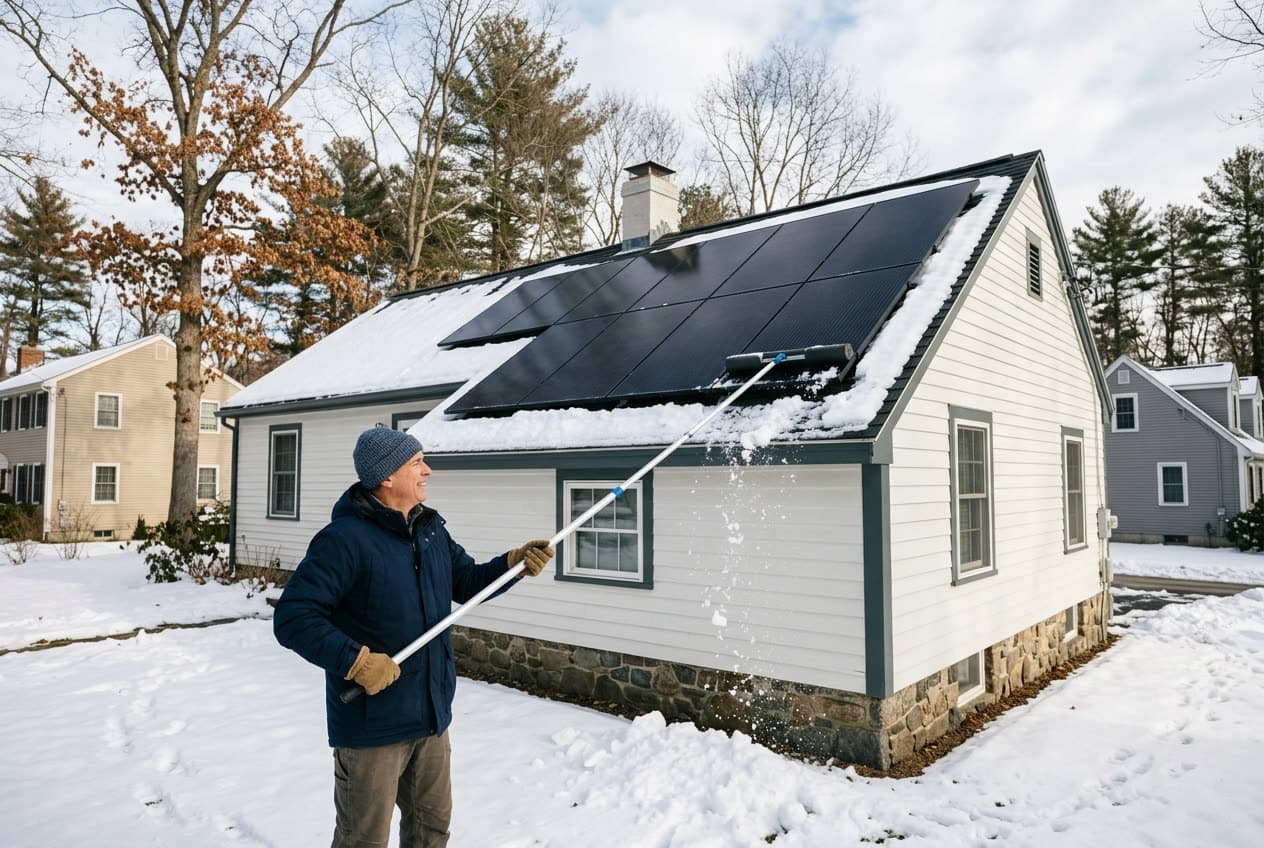
- Use a soft foam roof rake made for solar panels. Look for a foam or rubber head and a telescoping pole long enough to reach from the yard.
- Pull gently and leave a thin layer. Draw loose snow down toward the edge without pressing hard on the glass. The sun will melt the last bit.
- Skip anything hard, hot or chemical. No metal tools, shovels, ice scrapers or stiff brushes, which can scratch the glass or damage the frame and wiring. No hot water, which can stress cold glass and refreezes into ice. No salt or de-icer on the panels.
- Leave ice alone. If a sheet of ice has formed on the panels, don't chip at it. Wait for a sunny day.
Timing helps too. Fresh, fluffy snow comes off easily. Wet, packed snow is heavy, and that's when people start pushing too hard on the glass.
If you can't reach the panels safely from the ground, leave them. That's the right call for most two-story homes.
Don't risk your warranty
Every Evergreen Solar package includes a 25-year comprehensive solar warranty and a 25-year power production guarantee. Scratched glass, a cracked panel or wiring pulled loose by a scraper or shovel is the kind of damage you don't want to argue about later. When in doubt, let the snow melt.
Can snow slide off solar panels onto walkways?
Yes. Snow tends to leave smooth panels faster than it leaves shingles, and it often goes all at once. A sheet of wet snow or ice dropping off a roof edge can land hard on a walkway, a deck, a car or a person.
A few habits help:
- Keep people, pets and cars clear of the area below the panels after a storm, especially as it warms up.
- Watch entrances and paths that sit under the low edge of an array.
- Clear the landing area once snow comes down, so a pile doesn't block a door or a dryer vent.
If panels will sit above a door, a walkway or a driveway, ask your installer during the design whether snow guards make sense. These small brackets or bars on the roof below the panels help hold sliding snow in place so it melts off more slowly.
Can your roof handle solar panels and heavy snow?
A well-designed system accounts for snow from the start. Before the design is final, your installer checks that the roof structure can carry the panels and the snow that collects on them, and the racking attaches to the rafters, not just to the shingles. Local building codes set the snow loads a roof has to handle.
If your roof is older, have it looked at before solar goes on. Our guide to solar and your roof covers roof age, condition and leaks.
After an unusually heavy storm, look at the array from the ground. Signs like a panel sitting at a different angle from the rest or a sagging section of roof are reasons to call your installer. Don't go up to look closer.
What if production stays low after the snow melts?
Your monitoring app will tell you. Once the panels are clear on a sunny day, production should bounce back. It's normal for panels or microinverters to show as not reporting while they're buried, and that usually clears once the snow is gone.
It also helps to know what a normal winter looks like for your system. Compare this January with last January in the app, not with July. A lower number in midwinter is expected. A number well below the same month last year, in similar weather, is worth a question.
If the panels look clear but production stays low for a few sunny days, or one part of the array still isn't reporting, call your installer. With a lease or PPA, call the company that owns the system, sincemaintenance and repairs are its responsibility, not yours.
Questions about how solar would handle winter on your roof? Call us at (508) 507-2908, and we'll show you how your system's estimate accounts for New England weather.
Frequently asked questions
Do solar panels melt snow on their own?
They help it along. Panels are tilted and their dark glass absorbs sunlight, so once the sun reaches them, the snow warms from underneath and tends to slide off in sheets. The timing depends on the storm, the temperature and how much sun follows. Panels in full sun usually clear well before the rest of the roof.
Can you use a roof rake on solar panels?
Only one made for solar panels. Look for a roof rake with a soft foam or rubber head and a long telescoping pole, and use it from the ground to pull loose snow down. An ordinary metal or hard plastic roof rake can scratch the glass and damage the panel frame or wiring.
Should I pour warm water on snowy solar panels?
No. Hot or warm water on cold glass can stress the panel, and the water usually refreezes into ice on the panels or along the roof edge. De-icers and salt can damage the panels and frames too. If snow or ice won't come off with a soft roof rake from the ground, let the sun finish the job.
Is it safe to go on the roof to clear solar panels?
No. A snowy roof is slippery and can hide hazards, and OSHA advises removing snow without going onto the roof whenever possible. Stepping on panels can also crack the cells inside them. If snow on your roof truly needs to come off, use a tool from the ground or hire a professional with proper fall protection.
Your next step
See what solar would do for your home
We design a system for your roof and show you the numbers for every way to pay. Free, with no pressure.
Get my free solar quoteKeep reading
How we wrote this
This page was written by the Evergreen Solar team, which designs and installs home solar across Massachusetts, Rhode Island, Connecticut, New Jersey and Pennsylvania. Program rules and rates change, so we check every figure against the primary source listed below and note the date we last did. If something has changed, tell us at our contact page.