Key takeaways
- Going solar follows the same path for almost every home: check your roof, compare quotes, approve a design, sign, wait for permits and utility approval, install, pass inspection, then turn the system on. The installation itself takes a day or two. Most of the calendar, usually about 10 to 16 weeks from signing to activation, is design and approvals your installer handles.
- The installer you choose matters more than the panel brand. Look for a licensed, local company that designs from your actual electric bill, prices every way to pay on the same system, and explains the warranties in writing. Be wary of anyone who calls you out of the blue or pushes you to sign that day.
- Compare quotes on the same terms: system size, expected yearly production, equipment, warranties, who applies for your state incentive, and the total cost of each payment option. A low monthly payment can hide fees, so ask for the full total, not just the first number.
- Your system can't turn on until the town inspects it and the utility gives permission to operate. Net metering credits start only after that approval, so it helps to know what each step is for and who handles it before you sign.
- After installation, solar asks very little of you. A monitoring app shows what the panels produce, New England rain and snow do most of the cleaning, and warranties cover the equipment. With a lease or PPA, the company that owns the system handles maintenance and repairs.
Going solar sounds like a big project, and in a way it is: new equipment on your roof, a contract, your town and your utility all involved. But most of the work is done by your installer, and the steps are the same for almost every home. Once you know what each one is for, the process is easy to follow.
This guide walks through every stage, from checking whether your roof is a fit to the day your utility lets you turn the system on, and what owning solar looks like after that.
What are the steps to going solar?
A home solar project has eight steps. The first four are about choosing the right system and the right company. The last four are about getting it approved, installed and turned on.
| Step | What happens | Who does the work |
|---|---|---|
| 1. Check your roof | A quick look at sun exposure, roof space and roof condition | You, with an online scan or the installer |
| 2. Compare quotes | Proposals with a system size, expected production, price and payment options | You and the installers you contact |
| 3. Site visit and design | Measurements, a look at your roof and electrical panel, a final design | Installer |
| 4. Sign the contract | You choose how to pay and review the warranties and incentive details | You |
| 5. Permits and approvals | Building and electrical permits, the utility application, your state incentive application | Installer |
| 6. Installation | Racking, panels, wiring, inverters and monitoring go in | Installer's crew |
| 7. Inspection | The town inspects the work | Town inspector, with the installer |
| 8. Permission to operate | The utility approves the system and you turn it on | Utility, then you |
Steps 5, 7 and 8 take the most time, and you can't speed them up by much. What you control is the first half: picking a company that designs the system well and handles the approvals without letting your project sit.
How do you choose a solar installer?
You will live with your installer's work for 25 years or more, so choose the company before you choose the panels. A good installer is local, licensed, and easy to reach after the sale, not only before it. The U.S. Department of Energy recommends checking that an installer is licensed and certified by a reputable organization.
Signs you're talking with the right company:
- They ask for your electric bill. A system should be sized from your real usage, not a guess. Here's why installers ask for it.
- They price every way to pay. Cash, loan, lease, PPA and prepaid PPA on the same design, so you can compare the monthly cost and long-term savings side by side.
- They explain the incentives for your state and who applies for them, in writing.
- They tell you when solar doesn't fit. A heavily shaded roof or a roof that needs replacing soon should come up in the first conversation.
And the warning signs: calls or door knocks you didn't ask for, pressure to sign the same day, claims that a government program pays for everything, or a contract you're asked to sign on a tablet without seeing the whole agreement. The Federal Trade Commission warns about each of these. Our guide to "free" solar panels covers the offers that aren't what they sound like, and our solar FAQs double as a list of questions to ask any company. At Evergreen Solar we only contact homeowners who ask to hear from us, and you can read how we operate.
How do you compare solar quotes?
Two quotes for the same house can look very different, and the lower monthly payment isn't always the better deal. Line them up on the same terms:
- System size and expected production. Size is in kilowatts; production is the kilowatt-hours a year the system should make. Production is what saves you money, so compare it with your yearly usage.
- Equipment. The panel and inverter brands and models, and whether the system uses microinverters or a string inverter. Our guide to microinverters vs. string inverters explains the difference.
- The full cost of each payment option. For a loan, ask for the APR, the term and the total of payments, and whether a dealer fee is built into the price. Our guide to solar loan rates and dealer fees shows what to look for. For a lease or PPA, ask for the rate and whether it rises each year.
- Incentives. Which state programs the quote assumes, and who applies for them.
- Warranties and guarantees. What's covered, for how long, and by whom (more on that below).
Then compare the monthly cost with what you pay the utility now. For most homes the solar payment is lower, and across Evergreen Solar customers, savings average about 15% on day one. Our guide to solar financing compares the five ways to pay, and what solar costs and saves covers the numbers.
Our Day One Savings Guarantee
We compare your solar quote with your average electric bill. If the quote isn't lower, we'll contact you and offer to cancel your consultation, so your time isn't wasted on a quote that's higher than your bill. It covers solar-only projects and compares the quote with your bill; it isn't a guarantee of production.
What happens during the site visit and design?
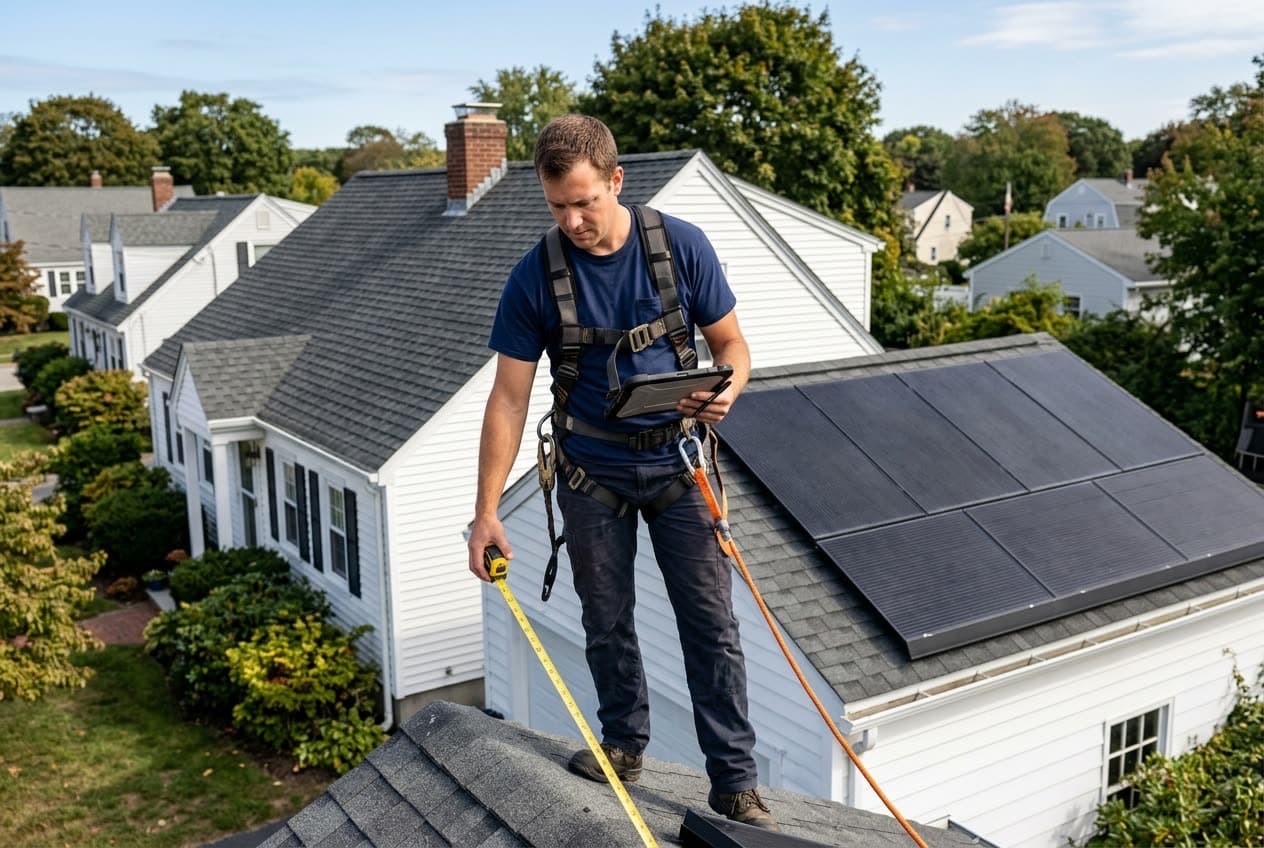
Early quotes are often built from satellite images and your bill. Before anything is final, the installerchecks the house in person, or with detailed measurements, to confirm the design will work. At Evergreen Solar, that site survey happens within 7 to 10 days of signing up and covers your roof, attic and electrical system, and we review any changes from the initial design with you before the plans are final.
- Your roof. Its direction, pitch, shade and open space decide how many panels fit and how much each one produces. The installer also looks at the roof's age and condition. Is your roof a good fit for solar? walks through what they check.
- Your electrical panel. The system connects to your home's main panel, so the installer checks its size and space for a new breaker.
- Your usage. If you plan to add an electric car or a heat pump, say so now. The system can be sized for the home you'll have, not just the one you have today. Our guide to solar in an all-electric home explains why that matters.
The final design places each panel and estimates production from historical weather data for your area, so the system averages out over a full year of sunny summers and short winter days.
If your roof will need replacing within the next several years, this is the moment to deal with it. Taking panels off and putting them back later costs money that a new roof now avoids. Our roof + solar package includes the new roof with your solar installation at a reduced price, the total often costs less than your current electric bill, and those roofs carry a 50-year warranty. Read more on getting a new roof and solar at the same time.
What should you check before you sign a solar contract?
The contract turns the quote into a promise, so read it with the quote next to you. Before you sign, make sure it states:
- The system size, the equipment, and the production estimate from the design.
- The price and the payment option you chose, with every fee listed.
- Each warranty or guarantee, how long it lasts, and who stands behind it.
- Which incentives the price assumes and what happens if one isn't approved.
- What happens if you sell the house while the contract is running.
- Your right to cancel and how to use it.
Each state adds its own paperwork. In Massachusetts, the installer applies to SMART 3.0 for you and gives you a disclosure form. In Connecticut, you sign an RRES customer disclosure form before the solar contract, and you choose between Netting and Buy-All, a choice that stays with the house. In Rhode Island, a contract that uses the Renewable Energy Fund grant must show the grant amount and what happens if it isn't approved. Our guides to SMART 3.0, Connecticut's RRES program and the Rhode Island solar grant cover each one.
You also have time to change your mind. The FTC's Cooling-Off Rule gives you three business days to cancel many sales made in your home, and the seller has to tell you about that right and give you cancellation forms. Check your contract for its exact cancellation terms. If you're thinking about selling within a few years, our guide to selling a house with solar panels explains how each ownership type transfers.
What permits and approvals does solar need?
After you sign, your installer files the paperwork. You may be asked for a signature or a copy of a bill, but you shouldn't have to chase anyone. There are three tracks, and they often run at the same time:
- Town permits. A building permit for the racking and an electrical permit for the wiring. Each town sets its own process and review time.
- Utility interconnection. The installer applies to your utility to connect the system to the grid. In Connecticut, Eversource reviews the RRES application together with the interconnection application.
- Your state incentive. SMART 3.0 in Massachusetts and RRES in Connecticut. In Rhode Island, the Renewable Energy Fund grant has to be approved before installation starts, and the grant runs in funding rounds.
On our projects, permits from the town and approval from the utility typically take 4 to 6 weeks. The Department of Energy notes the same pattern nationally: installation takes only a few days, while permits and inspections can take weeks to months. Most of the waiting happens here, and it varies by town and utility.
What happens on installation day, and when can you turn it on?
The installation itself typically takes one to two days. The crew attaches racking to the roof and seals each attachment, mounts the panels, runs wiring to your electrical panel, installs the inverter or microinverters and any battery, and sets up monitoring. The power may be off for a short time while they connect the system. You don't need to be home the whole time, but the crew needs access to the electrical panel.
Then two approvals stand between you and solar power:
- Town inspection. An inspector checks the work against the permits. Your installer schedules it and is usually there for it.
- Permission to operate. Once the system passes inspection, the utility gives final approval. Your installer tells you when it's official, and you turn the system on.
Don't switch the system on before permission arrives. Net metering credits start only after the utility authorizes the system. After that, extra power your panels make on sunny days becomes credits on your bill. Our guides to how net metering works and your electric bill with solar show what the first bills look like.
What does owning solar look like after installation?
Solar is about as low-maintenance as anything on a house. Panels have no moving parts, and New England rain and snow wash off most of the dust and pollen. Here is what ownership involves:
- Monitoring. An app on your phone or computer shows what the system produces, what your home uses, and the health of the system. A sudden drop is the clue to call your installer.
- Snow. Snow slides off panels on its own once the sun hits them. Don't climb on the roof or scrape the panels, because you can damage them.
- Outages. A grid-tied system without a battery shuts off during a power outage, for the safety of the crews fixing the lines. A home battery keeps your essentials running.
- Your roof and insurance. Tell your insurer when the panels go on, and plan for any future roof work to include taking panels off and putting them back.
Warranties are what protect you over the system's life, so know which ones you have:
| Coverage | What it covers | What to ask |
|---|---|---|
| Panel product warranty | Defects in the panels themselves | How long, and who handles a claim |
| Panel performance warranty | Output dropping faster than promised as the panels age | How much output is guaranteed by the final year |
| Inverter warranty | The inverter or microinverters | Whether it's shorter than the panel warranty |
| Workmanship warranty | The installer's work: wiring, racking, roof attachments | How long, and whether it covers leaks at roof attachments |
| Production guarantee | The system making the energy the contract promises | How a shortfall is measured and paid |
Every Evergreen Solar package includes a 25-year comprehensive solar warranty and a 25-year power production guarantee: if the panels don't produce what we promised, we cover the difference. With a lease or PPA, the company that owns the system handles maintenance and repairs, so they aren't on your budget. Panels last 25 to 35 years on average, which is why the installer's staying power matters as much as the equipment.
How long does going solar take, and when should you start?
Most of the time goes to design and approvals, not to the work on your roof. Here is how a typical Evergreen Solar project runs once you sign up:
| Stage | Typical time | What happens |
|---|---|---|
| Get started | At signing | Your Solar Pro finalizes the system size and design and completes any lending paperwork |
| Site survey | 7 to 10 days | A detailed survey of your roof, attic and electrical system |
| Blueprints | 2 to 3 weeks | The design team draws the plans used for permits and reviews any changes with you |
| Permitting | 4 to 6 weeks | Applications go to your town and your utility for approval |
| Installation | 1 to 2 days | The crew installs the system |
| Activation | 3 to 5 weeks | The town inspector approves the work, the utility installs your new meter, and you turn the system on |
Added up, that's usually about 10 to 16 weeks from signing to activation. A town with quick permits or a utility with a short queue moves faster; a busy one takes longer. Whoever you work with, ask for a schedule for your town and utility and how they'll keep you updated.
The season matters less than you might think. Panels can go on in any season, and starting in fall or winter means the system is producing by the long days of spring and summer. Our guide to the best time to install solar panels goes deeper.
A few dates make starting sooner worth it:
- Leases and PPAs: you get a lower rate because the system qualifies for the 30% federal credit, and systems that begin construction after July 4, 2026 must be in service by December 31, 2027 to qualify. Our guide to the tax credit on leased solar explains how it lowers your rate.
- Massachusetts: SMART 3.0 locks the rate for the year you enroll. The 2026 rate is $0.03 per kilowatt-hour ($0.06 for income-qualified homes), and the 2027 rate hasn't been set yet.
- Connecticut: RRES locks your rate by the year your application is received, and the program runs through the end of 2027.
- Rhode Island: the grant runs in first-come, first-served rounds, and the 2027 rounds hadn't been announced as of October 2026.
The quickest way to start is to find out whether your home is a fit. Our free Solar Fit scan shows your roof's sun exposure and a preliminary design in about a minute, and a recent electric bill is all we need to price every way to pay. You can also see the incentives in your state on our pages for Massachusetts, Connecticut and Rhode Island, or our 2026 incentive guide.
Frequently asked questions
What are the steps to installing solar panels?
Most home solar projects follow eight steps: check whether your roof is a fit, get and compare quotes, have a site visit and final design, sign the contract, wait while the installer gets permits and utility approval, install the system, pass the town inspection, and receive the utility's permission to operate. After that, you monitor production and the system runs on its own.
How long does it take to install solar panels?
The work on your roof usually takes one to two days. The whole project takes longer: for a typical Evergreen Solar project, about 10 to 16 weeks from signing to activation. That covers a site survey within 7 to 10 days, blueprints in 2 to 3 weeks, town and utility permits in 4 to 6 weeks, installation, then 3 to 5 weeks for inspection and the utility's new meter. Timing varies by town and utility.
Do I need to be home on installation day?
Usually only for part of it. The crew needs access to your roof, your electrical panel and the spot where the inverter or other equipment will be mounted, and the power may be off for a short time while they connect the system. Your installer will tell you what access they need before the day.
Can I turn my solar panels on as soon as they're installed?
No. The system has to pass your town's inspection, and then your utility has to grant permission to operate. Net metering credits start only once the utility authorizes the system, and your installer will tell you when it's official.
Do solar panels need maintenance?
Very little. Panels have no moving parts, and New England rain and snow clean most of the dust and pollen off them. Check your monitoring app now and then so a drop in production shows up quickly, and leave roof work and snow to professionals. With a lease or PPA, the system owner handles maintenance and repairs.
What happens to my solar panels during a power outage?
A grid-tied system without a battery shuts off during an outage so it can't send power onto lines that utility crews are repairing. It turns back on by itself when the grid returns. If you want power during outages, a home battery stores solar energy and keeps your essentials running.
Your next step
See what solar would do for your home
We design a system for your roof and show you the numbers for every way to pay. Free, with no pressure.
Get my free solar quoteKeep reading
How we wrote this
This page was written by the Evergreen Solar team, which designs and installs home solar across Massachusetts, Rhode Island, Connecticut, New Jersey and Pennsylvania. Program rules and rates change, so we check every figure against the primary source listed below and note the date we last did. If something has changed, tell us at our contact page.
Sources
- U.S. Department of Energy: Walk Me Through It, a step-by-step guide for consumers going solar
- FTC Cooling-Off Rule (16 CFR Part 429, eCFR)
- Federal Trade Commission: Solar energy is rising in popularity, and so are scams (Sept. 2024)
- New York Attorney General: Going Solar, a consumer guide (2020)
- MassCEC: Your guide to Massachusetts' SMART 3.0 program (June 10, 2026)
- Eversource: Massachusetts net metering FAQ
- Eversource: Connecticut Renewable Energy Solutions interconnections
- Commerce RI: Renewable Energy Fund small-scale solar program
- U.S. Department of Energy: End-of-life management for solar photovoltaics
- Eide Bailly: One Big Beautiful Bill energy credit changes (48E timing)