Key takeaways
- Installing solar panels on your roof usually takes one to two days. The whole project takes longer: a typical Evergreen Solar project in Massachusetts runs usually about 10 to 16 weeks from signing to activation. Most of that time goes to design, town permits and utility approval, and it varies by town and utility.
- Permits and approvals are the longest stage, usually about 4 to 6 weeks on our projects. Your installer applies for the town's building and electrical permits, files the interconnection application with Eversource or National Grid, and files your SMART 3.0 application. Much of that paperwork moves at the same time.
- After installation, activation usually takes about 3 to 5 weeks. The town inspector signs off, a certificate of completion goes to the utility, and the utility installs a new meter. You can't switch the system on until the utility approves it, and net metering credits start only after that approval.
- You can keep a project moving by returning signatures and lending paperwork quickly, settling roof or electrical work before the blueprints are drawn, and avoiding late design changes. Town permit backlogs, utility review queues and weather on installation day are the main delays that nobody fully controls.
The crew on your roof is the fast part. Most of the time between saying yes to solar and making your own power goes to design, permits and utility paperwork, and in Massachusetts that paperwork runs through your town, your utility and the state's SMART 3.0 program.
This article walks through each stage on a typical Evergreen Solar project, what happens during it, and why some projects finish faster than others. For the full set of steps, from comparing quotes to owning the system, see our guide to going solar, step by step.
How long does it take to install solar panels?
The installation itself usually takes one to two days. The whole project, from signing to the day the utility lets you turn the system on, usually takes about 10 to 16 weeks. The U.S. Department of Energy describes the same pattern nationally: a few days of work on the house, and weeks to months of permits and inspections around it.
| Stage | Usually about | Who's working | What you can do |
|---|---|---|---|
| Site survey | 7 to 10 days after signing | Our survey team, at your home | Clear a path to the attic and electrical panel |
| Blueprints | 2 to 3 weeks | Our design team | Review any changes from the first design quickly |
| Permitting | 4 to 6 weeks | Your town and your utility, with us filing | Sign and return any forms the same day |
| Installation | 1 to 2 days | Our install crew | Give the crew access to the panel and the roof |
| Activation | 3 to 5 weeks | Town inspector, then your utility | Wait for the go-ahead before switching on |
Those are the usual ranges, not promises. Each Massachusetts town runs its own permit office, and Eversource and National Grid each run their own review queue, so the same design can move faster in one town than in the next one over.
What happens in the first few weeks after you sign?
Before you sign, your Solar Pro finalizes the system size and design and completes any lending paperwork. Then the project moves into two stages that set up everything after them.
The site survey, within 7 to 10 days. A surveyor checks your roof, your attic and your home's electrical system in person. The attic visit confirms how the panels will attach to the roof framing. The electrical check confirms your main panel can take the new connection, or flags that it needs work.
Blueprints, about 2 to 3 weeks. Our design team turns the survey into the plans your town and utility will review. If the survey changed anything from the first design, such as a panel moved for a vent or a different layout on a second roof face, we go over it with you before the plans are final.
This is the stage where decisions save the most time later. A roof replacement, a panel upgrade or a battery is easiest to add now, while the plans are still being drawn.
Why do permits and utility approval take the longest in Massachusetts?
On our projects, permitting usually takes about 4 to 6 weeks. Three pieces of paperwork move through different offices, and each one has its own queue:
- Town permits. Your town's building department reviews the racking and roof attachment, and the electrical permit covers the wiring. Every town sets its own process and review time.
- Utility interconnection. We apply to Eversource or National Grid to connect the system to the grid, and the utility checks the design against its rules.
- SMART 3.0. We apply to the state's solar incentive for you and give you a disclosure form. It pays a flat $0.03 per kilowatt-hour for 2026 ($0.06 for income-qualified homes), locked for the year you enroll and paid monthly for up to 20 years on top of net metering. SMART 3.0 covers Eversource, National Grid and Unitil customers. Our guide to SMART 3.0 covers the details.
Because these run side by side, the slowest of the three usually sets the pace. Your part is small: a signature on the utility application or a copy of a recent bill, which is one reason installers ask for your electric bill early.
How long does installation day take?
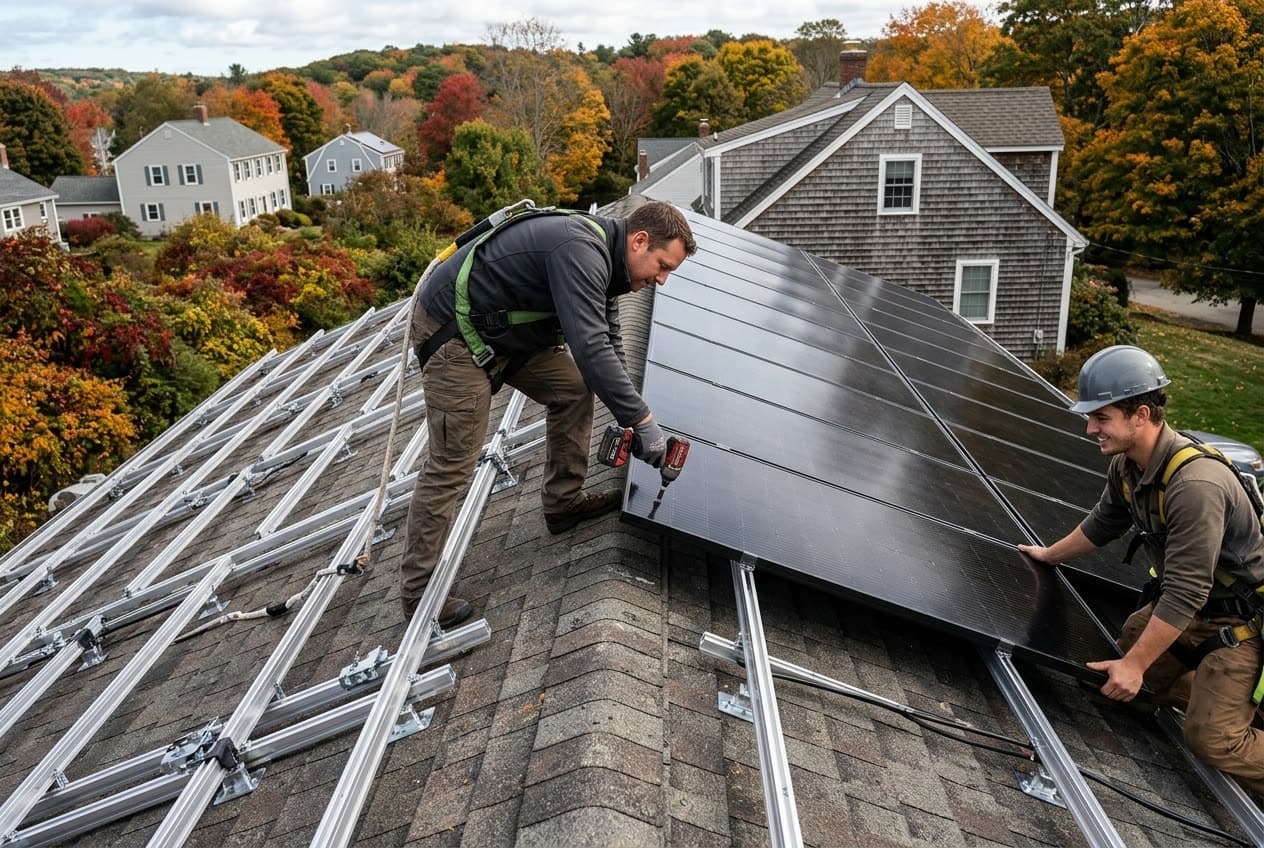
Usually one to two days. On the first morning the crew sets up safety equipment and starts attaching the racking to the roof framing, sealing each attachment as it goes. Then the panels go on, the wiring runs to your electrical panel, and the inverter or microinverters, any battery and the monitoring equipment are installed.
A simple roof often finishes in a day. Several roof faces, a steep pitch, a battery or a panel upgrade can stretch the work into a second day. Your power may be off for a short time while the crew connects the system to your panel.
Weather is the one thing that can move the date. Crews won't work on a roof covered in snow or ice, or in heavy rain or high wind, so a stormy week can push your install back a few days.
What happens between installation and turning the system on?
Activation usually takes about 3 to 5 weeks after installation. First your town's inspector checks the work against the permits. Once it passes, a certificate of completion goes to the utility, and the utility installs your new meter and gives final approval, often called permission to operate.
Don't turn the system on before that approval arrives. With Eversource, net metering credits start only once the system is authorized to operate, and they show on your bill under "Other Charges or Credits." Our guide to how net metering works explains what those credits are worth, and your electric bill with solar shows what the first bills look like.
What speeds up or slows down a solar project?
Some of the timeline is in your hands, and some isn't.
What keeps a project moving:
- Returning signatures, lending documents and utility forms the day you get them.
- Deciding on a new roof, a battery or electrical work before the blueprints are drawn.
- Being easy to reach for the site survey and the inspection.
What can slow it down:
- A busy town permit office or a long utility review queue.
- Design changes after the plans have gone in, which can send them back for review.
- An electrical panel that needs upgrading, which adds work to the plans.
- Snow, ice or storms on the scheduled installation day.
- A correction from the inspector, which means a fix and a second visit.
Timing also matters for how you pay. If you choose a lease or PPA, you get a lower rate because the system qualifies for the 30% federal credit, and systems that begin construction after July 4, 2026 must be in service by December 31, 2027 to qualify. A project signed this fall, on the usual 10 to 16 week schedule, has plenty of room. Our guide to the tax credit on leased solar explains how it lowers your rate, and our solar financing guide compares every way to pay.
Season matters less than most people think, since the approvals take the same time all year. Our article on the best time to install solar panels covers why starting in fall or winter works well. Want a schedule for your town and utility? Call us at (508) 507-2908, or see the incentives on our Massachusetts solar page.
Frequently asked questions
How long does it take to get solar panels installed after signing?
On a typical Evergreen Solar project, the site survey happens within 7 to 10 days of signing, blueprints take about 2 to 3 weeks, and town and utility permits take about 4 to 6 weeks. The crew then installs the system in one to two days. That puts installation usually about 7 to 11 weeks after signing, depending on your town and utility.
Who applies for the permits and SMART 3.0 in Massachusetts?
Your installer does. The installer applies for the town's building and electrical permits, files the interconnection application with your utility, and applies to SMART 3.0 for you, then gives you a disclosure form. You may be asked for a signature or a copy of your electric bill, but you shouldn't have to deal with the town or the utility yourself.
Can solar panels be installed in winter in Massachusetts?
Yes. Panels can go on in any season, and a project started in fall or winter is usually producing by the long days of spring and summer. Snow, ice or heavy rain on the scheduled day can push the crew back a few days for safety, but the permits and utility approval, which take most of the time, carry on all year.
Does adding a new roof make a solar project take longer?
Not by much if you decide early. With the Evergreen Solar roof + solar program, the roof goes on in one day and the solar in another. The key is choosing the roof work before the blueprints are drawn, so the plans and permits cover the finished roof and nothing has to be redone.
Your next step
See what solar would do for your home
We design a system for your roof and show you the numbers for every way to pay. Free, with no pressure.
Get my free solar quoteKeep reading
How we wrote this
This page was written by the Evergreen Solar team, which designs and installs home solar across Massachusetts, Rhode Island, Connecticut, New Jersey and Pennsylvania. Program rules and rates change, so we check every figure against the primary source listed below and note the date we last did. If something has changed, tell us at our contact page.