Key takeaways
- In New England, south-facing solar panels collect the most energy over a year, because the sun crosses the southern half of the sky. But south isn't required. Southeast and southwest roofs come close, and east- and west-facing roofs still produce well enough that many homes use them, often on both slopes of the same roof.
- North-facing roofs are usually a poor fit for solar panels in New England. They get the least direct sun, especially in winter when the sun sits low in the southern sky. Most homes with a north slope have a better slope on the other side, and a gently pitched north roof is judged case by case.
- The Department of Energy says solar panels typically perform best on south-facing roofs with a slope between 15 and 40 degrees, though other roofs may be suitable. Most pitched New England roofs fall in or near that range, so roof angle rarely rules a home out. Flat roofs use racking that tilts the panels.
- You don't have to guess what your roof will produce. An installer models your exact roof, with its direction, pitch and shade, against years of historical weather data for your area. That estimate shows whether solar makes sense for your home before you commit to anything.
If your roof doesn't face south, you may have assumed solar isn't for you. That's one of the most common worries we hear, and most of the time it isn't true.
This article explains which direction solar panels should face in Massachusetts, Rhode Island and Connecticut, how much roof angle matters, and how an installer figures out what your roof will actually produce. For the full list of roof questions, start with our guide to solar and your roof.
Why do south-facing solar panels collect the most energy?
New England sits well north of the equator, so the sun travels across the southern half of the sky all year. It rises in the east, swings to the south at midday and sets in the west. A roof that faces south looks straight at that path for most of the day.
The effect is strongest in winter. In December the sun stays low in the southern sky, so a south-facing roof catches it at a better angle than any other side of the house. In summer the sun climbs higher and rises and sets farther to the north, which spreads the light more evenly across east and west roofs too.
That's why south is the reference point. The Department of Energy's Building America program recommends giving solar panels as much south-facing roof as possible on new homes. But that guidance is about getting the most from every panel. It doesn't mean other directions don't work.
A quick way to check your own roof: stand in the yard at midday and notice where the sun is. The roof slope that faces it most directly is your south side. Very few homes line up exactly with the compass, and they don't need to.
Are east- and west-facing roofs good for solar panels?
Yes, in most cases. Roofs that face southeast or southwest come very close to due south. The Building America guide, drawing on research from the National Renewable Energy Laboratory, says that across most of the country a well-tilted panel can turn about 65 degrees east or west of due south and still receive 90 to 100 percent of the energy available to it.
Roofs that face due east or due west produce less than south, but they still produce well. East catches the morning sun and west catches the afternoon. Neither one sees the sun for the whole day, so each panel makes somewhat less over a year. The system makes up for that with a few more panels or by using more of the roof.
That's where many New England homes come out ahead. A typical gable roof with a ridge running north to south has one slope facing east and one facing west. Putting panels on both sides spreads production across the whole day and often fits a full-size system on a roof that has no south side at all.
| Roof faces | Sun it catches | What to expect |
|---|---|---|
| South | Most of the day, all year | The most production per panel |
| Southeast or southwest | Most of the day, tilted toward morning or afternoon | Close to south; a strong fit |
| East or west | Morning (east) or afternoon (west) | Produces well; often paired across both slopes |
| North | Little direct sun, especially in winter | Usually a poor fit, unless the pitch is very low |
Can solar panels work on a north-facing roof?
Usually not well. A north-facing roof tilts away from the sun's path, so it gets the least direct light of any side of the house. The gap is biggest in winter, when the low sun barely reaches a steep north slope at all.
Pitch changes the picture a little. A very gently sloped north roof sits close to flat, so it faces the sky more than it faces away from the sun. An installer may use a section like that when the rest of the roof is full. A steep north slope, the kind common on Cape-style homes, is rarely worth covering.
The good news is that a north slope almost always has a partner. If the back of your house faces north, the front faces south, and that's the side we'd look at first.
What is the best angle for solar panels?
The rule of thumb
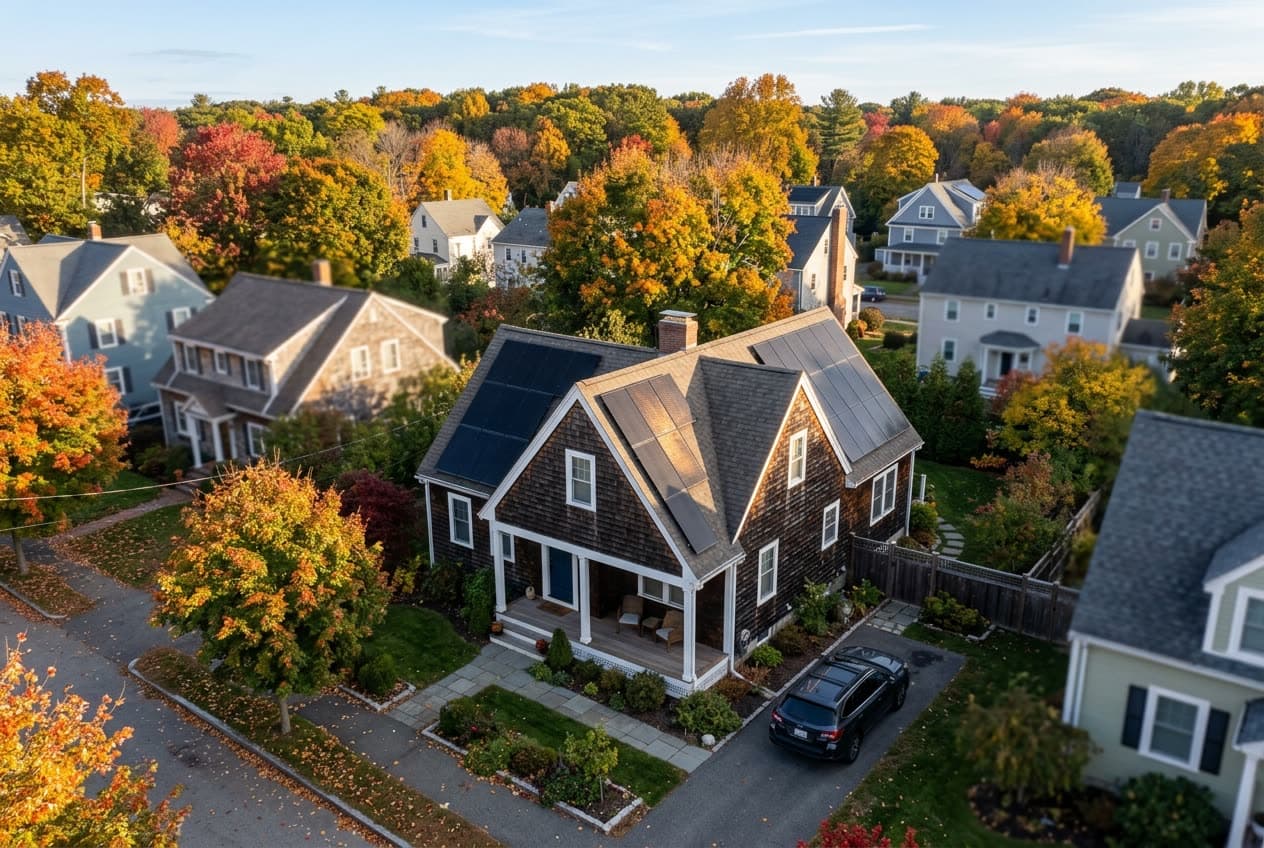
The Department of Energy says solar panels typically perform best on south-facing roofs with a slope between 15 and 40 degrees, though other roofs may be suitable.
On a pitched roof, the panels sit just above the shingles and follow the roof's slope, so your pitch sets the angle. Most pitched New England roofs land in or near that 15 to 40 degree range. Even outside it, the loss is modest. The same Building America guide notes that a south-facing panel can sit anywhere from flat to about 55 degrees and still receive 90 to 100 percent of the energy available to it.
That's why direction usually matters more than pitch. A few practical points still apply:
- Steeper roofs favor winter. A steep pitch faces the low winter sun more squarely and tends to shed snow sooner. Our article on solar panels and snow covers what happens after a storm.
- Shallower roofs favor summer. A low pitch catches the high summer sun well and gives east- and west-facing panels a better view of the sky.
- Flat roofs use tilted racking. On a flat or low-slope roof, the racking holds the panels at an angle so they face the sun and shed rain and snow.
Shade can matter even more than direction or pitch: a south roof under tall trees can produce less than an open west roof.
How does an installer estimate production for your roof?
You don't have to work out any of this yourself. A good installer models your actual roof, not an ideal one. That means the direction each roof face points, its pitch, the space around vents and chimneys, and the shade from trees and nearby buildings.
That roof model is then run against historical weather data for your area, which covers the cloudy weeks, the snowy ones and the long summer days. Evergreen Solar designs every system this way, so the yearly production estimate reflects your roof and your local weather.
Direction shows up clearly in that design. Panels go on the roof faces that earn their place, and a shaded or north-facing section is simply left empty. The goal is a system that produces enough over the year to make the savings work, not one that covers every square foot of roof.
The estimate is checked in person, too. During the consultation and site survey, the team confirms the roof, the attic and your electrical system before the design is final. Our guide to how home solar works explains what happens to the power your panels make once they're running.
What if your roof faces the wrong way?
First, it may not. East, west, southeast and southwest roofs all work, and a mix of them is common. Our original post on whether your roof is a good fit for solar walks through orientation alongside the other things that decide fit, like roof age, space and local rules.
If the main roof truly isn't a fit, a few things are worth checking:
- Other roof sections. A garage, porch or addition may face a better direction than the main roof.
- Both slopes together. Two partly good slopes can add up to one good system.
- The bill you're offsetting. A smaller system on your best roof faces can still cut your bill, and net metering credits the extra power you send to the grid on your bill (Connecticut uses its own RRES program).
And if solar isn't right for your home, we'll tell you. Call Evergreen Solar at (508) 507-2908, and we'll look at which way your roof faces and show you what it could produce.
Frequently asked questions
Is it better for solar panels to face east or west?
Over a full year, east and west produce similar amounts. East catches the morning sun and west catches the afternoon sun. Which one comes out ahead on a given home depends on shade from trees and nearby buildings, local weather patterns and the roof's pitch. Many homes put panels on both sides to fit a full-size system.
Can solar panels face north in Massachusetts?
They can, but it's rarely worth it. A north-facing roof gets the least direct sun, and the gap is widest in winter. A very low-pitched north roof does better than a steep one, so an installer may include it in a few cases. If north is your only open roof, ask about other options before ruling solar out.
What is the best tilt angle for solar panels in New England?
The Department of Energy says panels typically perform best on south-facing roofs sloped between 15 and 40 degrees. Most rooftop panels sit flat against the roof, so your roof's pitch sets the angle. A slightly steeper or shallower roof changes yearly production only modestly, which is why pitch matters less than direction.
Do solar panels need direct sunlight to work?
They work best in direct sun but still make power in indirect light and on cloudy days, just less of it. That's why an east- or west-facing roof that sees direct sun for part of the day still produces well. Heavy shade for most of the day is a bigger problem than a less-than-perfect direction.
Your next step
Get a solar and roof assessment
We check your roof's condition, design your system, and price solar with or without a new roof. Free, with no pressure.
Get my roof + solar quoteKeep reading
How we wrote this
This page was written by the Evergreen Solar team, which designs and installs home solar across Massachusetts, Rhode Island, Connecticut, New Jersey and Pennsylvania. Program rules and rates change, so we check every figure against the primary source listed below and note the date we last did. If something has changed, tell us at our contact page.