Key takeaways
- Solar panels turn sunlight into direct current (DC) electricity. An inverter converts it to the alternating current (AC) your home uses, your home uses what it needs, and the extra goes to the grid as net metering credits you draw on at night and in winter.
- A home system has a few main parts: panels, racking that attaches them to the roof, one or more inverters, a monitoring app, and a utility meter that counts power in both directions. A battery is optional and adds backup power during outages.
- The number of panels you need comes from your electric bill, not a rule of thumb. The installer sizes the system to the kilowatt-hours you use in a year, then fits it to your roof's sunny space, so two homes of the same size can need very different systems.
- Solar works well in New England. Long summer days produce more than a home uses, and net metering credits carry that surplus into the shorter winter months. Panels still produce on cloudy days, and snow slides off once the sun hits it.
- Panels last 25 to 35 years on average and lose output very slowly. NREL's review of field data found a median loss of about 0.5% a year, and large systems in cooler climates lost less than those in hot ones. Evergreen Solar installs Tier 1 panels with a 25-year comprehensive solar warranty.
You don't need to understand the physics to go solar, but knowing how a system works makes every quote easier to read. What the inverter does, why the installer asks for your electric bill, and why the panels still pay off in a New England winter all come back to a few simple ideas.
This guide covers how panels make electricity, the parts of a home system, how solar works with the grid, how many panels a home needs, how much they produce here, and how long they last.
How do solar panels make electricity?
Each panel is made of solar cells, usually silicon. When sunlight hits a cell, the cell absorbs its energy, which sets electrical charges moving and makes electricity flow. The U.S. Department of Energy describes it as sunlight creating charges that move in response to an electrical field inside the cell.
That electricity comes out as direct current (DC), the kind a battery makes. Your home runs on alternating current (AC). So every grid-tied home system has one more step before the power reaches your outlets: an inverter.
From the roof to your outlets, it works like this:
- Sunlight hits the panels, and they produce DC electricity.
- Inverters convert it to AC.
- The AC power flows into your electrical panel and runs whatever is on in the house.
- Anything your home doesn't use right then flows out to the grid through your utility meter.
What are the parts of a home solar system?
A home system is simpler than it looks from the street. These are the main parts:
| Part | What it does | What to ask |
|---|---|---|
| Solar panels | Turn sunlight into DC electricity | Brand, wattage and both warranties |
| Racking | Holds the panels and attaches them to the roof | How attachments are flashed and sealed |
| Inverter(s) | Convert DC to the AC your home uses | Microinverters or a string inverter, and the warranty |
| Monitoring | Shows production, home use and system health in an app | What it tracks and who watches for problems |
| Utility meter | Records power coming in and going out | Who arranges the meter change |
| Battery (optional) | Stores power for outages and battery programs | Capacity, power output and which circuits it covers |
The wiring ties it together: from the panels to the inverters, to your electrical panel, and out through the meter. Your installer checks that your electrical panel can take the new connection. Our guide to solar and your roof covers what that check involves.
What does a solar inverter do, and which kind is best?
The inverter is the system's translator: it turns the panels' DC power into the AC your home and the grid use. It also manages how the panels produce and shuts the system down when the grid goes out. Our guide to what a solar inverter does goes deeper.
There are two main designs:
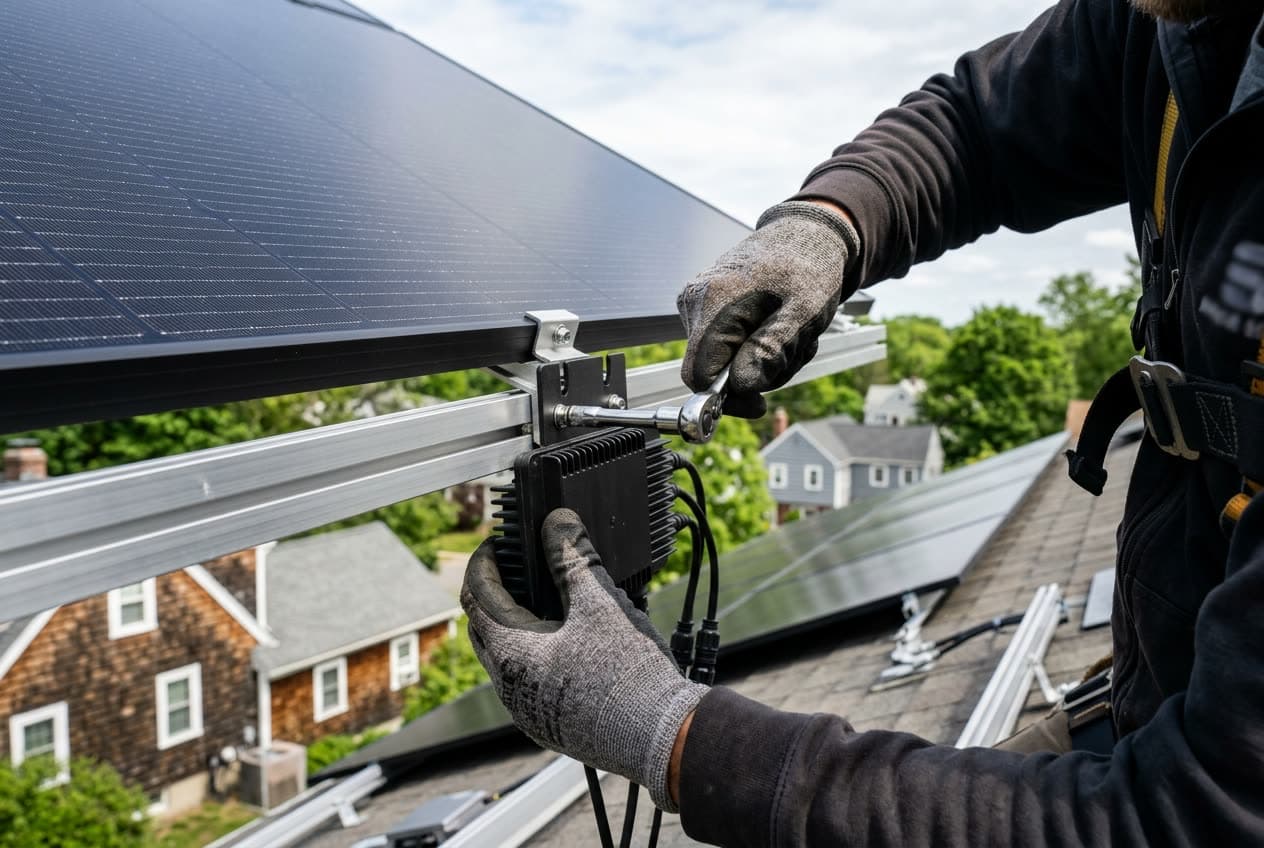
- Microinverters. A small inverter under each panel. Each panel works on its own, so shade or snow on one panel doesn't drag down the rest, and the monitoring app can show each panel's output.
- String inverter. One central inverter, usually mounted on a wall near your electrical panel, with the panels wired together in groups. It works well on large roofs with even, all-day sun.
On New England roofs, with chimneys, dormers and trees that throw shade at different times of day, microinverters are often the better fit. Our comparison of microinverters vs. string inverters walks through the trade-offs.
How does home solar work with the grid?
Almost every home system in Massachusetts, Connecticut and Rhode Island stays connected to the grid. That connection is what makes solar work through the night and the winter.
- During the day, your home uses solar power first. Extra power flows to the grid, and your utility credits you for it through net metering.
- At night and on dark days, your home draws from the grid, and those credits pay for it.
- Over the year, sunny months build up credits that carry forward to the darker months.
Your utility meter records power in both directions, and net metering credits start once the utility approves your system. Our guide to how net metering works explains the credits, and your electric bill with solar shows what they look like on the bill.
Solar and power outages
A grid-tied system without a battery shuts off during an outage, so it can't send power onto lines utility crews are repairing. To keep power when the grid is down, add a battery. Our guide to solar batteries and backup power covers how it works.
How many solar panels do you need?
The number of panels comes from your electricity use, not the size of your house. Two terms do most of the work:
- Kilowatt-hours (kWh) measure energy, what your electric bill charges you for. Your yearly total is the target the system is sized to.
- Kilowatts (kW) measure a system's size, its output in full sun. A bigger system makes more kilowatt-hours over a year.
The installer takes your past 12 months of electric bills, works out how many kilowatt-hours a system on your roof would produce, and sizes it to cover your use. The panel count then depends on each panel's wattage and how much sunny roof space you have. Here's why installers ask for your bill.
Plan ahead if your use is about to change. An electric car, a heat pump or an induction range all add to what the system needs to produce. Our guide to solar in an all-electric home covers that.
How much electricity do solar panels make in New England?
More than many people expect. New England gets less sun than the Southwest, but long summer days produce plenty, and the region's high electric rates make every kilowatt-hour your panels make worth more.
Production follows the seasons:
- Late spring and summer are the peak. Long days often produce more than a home uses, and the surplus becomes credits.
- Fall and winter produce less, with shorter days and a lower sun. Credits from summer help cover the gap.
- Cloudy days cut production but don't stop it.
- Snow slides off the panels once the sun reaches them.
Your installer estimates yearly production from historical weather data for your location, plus your roof's direction, pitch and shade, so the estimate reflects your home rather than a national average. Compare that production estimate between quotes: it's what your savings are built on. Our guide to the best time to install solar panels covers how the seasons affect timing.
How do you choose solar panels?
Most homeowners don't need to become panel experts. A few things are worth comparing between quotes:
- Wattage. Higher-wattage panels produce more each, so fewer fit the same output on a smaller roof.
- Efficiency. How much of the sunlight a panel turns into electricity. It matters most when roof space is tight.
- Warranties. The product warranty covers defects. The performance warranty covers how much output the panels keep as they age.
- The manufacturer. A company likely to be around to honor its warranty. Evergreen Solar installs Tier 1 equipment.
The panel brand matters less than the design and the installation. A system placed on the sunniest parts of the roof, with the right inverters and careful wiring, outperforms premium panels installed poorly. Our guide to going solar, step by step covers how to compare quotes and installers.
How long do solar panels last?
Solar panels last 25 to 35 years on average, and they don't stop working at the end of the warranty. They lose output slowly: NREL's review of nearly 2,000 field measurements found a median loss of about 0.5% a year. A later NREL study of large U.S. systems found that those in cooler climates lost output more slowly than those in the hottest regions.
Other parts have their own lifespans:
- Inverters often carry shorter warranties than panels, so check both.
- Your roof needs to last too. If it's aging, replace it as part of the project, which our roof + solar package is designed for.
Every Evergreen Solar package includes a 25-year comprehensive solar warranty and a 25-year power production guarantee: if the panels don't produce what we promised, we cover the difference. With a lease or PPA, the company that owns the system also handles maintenance and repairs. To see what a system would cost and save on your home, our guide to what solar costs and saves is the next step.
Frequently asked questions
How do solar panels work for your home?
Sunlight hits the cells in each panel and creates direct current electricity. An inverter changes it to alternating current, which flows into your electrical panel and powers your home. When the panels make more than you're using, the extra goes to the grid and earns net metering credits that cover the power you use at night and in winter.
Do solar panels work in winter and on cloudy days?
Yes. Panels produce less on short winter days and under heavy clouds, but they don't stop. Snow slides off once the sun reaches the panels. A New England system is designed for the whole year: summer produces extra, and net metering credits from those months help cover winter.
How many solar panels do I need for my house?
It depends on how much electricity you use, how much sun your roof gets and the panels' wattage. An installer sizes the system from your past 12 months of electric bills, then fits panels on the sunniest parts of your roof. Planning an electric car or heat pump adds to the size.
What happens to my solar panels when the power goes out?
A grid-tied system without a battery shuts off during an outage so it can't send power onto lines utility crews are repairing. It restarts on its own when the grid comes back. To keep power during outages, you need a battery, which stores solar energy and recharges from your panels.
How long do solar panels last?
25 to 35 years on average, and they keep producing well past their warranty. Output declines slowly: NREL's review of field data found a median loss of about 0.5% a year. Inverters often have shorter warranties than panels, so check both when you compare equipment.
Are some solar panels better than others?
Yes, but the differences matter less than the installation. Compare panel wattage, efficiency, the product and performance warranties, and the manufacturer's track record. A well-designed system with quality panels, installed by a company that stands behind its work, matters more than chasing the highest efficiency rating.
Your next step
See what solar would do for your home
We design a system for your roof and show you the numbers for every way to pay. Free, with no pressure.
Get my free solar quoteKeep reading
How we wrote this
This page was written by the Evergreen Solar team, which designs and installs home solar across Massachusetts, Rhode Island, Connecticut, New Jersey and Pennsylvania. Program rules and rates change, so we check every figure against the primary source listed below and note the date we last did. If something has changed, tell us at our contact page.
Sources
- U.S. Department of Energy: How does solar work?
- U.S. Department of Energy: Homeowner's guide to going solar
- NREL: Photovoltaic degradation rates, an analytical review (Jordan and Kurtz)
- pv magazine USA: NREL says long-term degradation of 8 GW of U.S. solar matches expectations (Jan. 29, 2024)
- U.S. Department of Energy: End-of-life management for solar photovoltaics (panel lifespan)
- Eversource: Massachusetts net metering FAQ