Key takeaways
- Yes, solar panels work on cloudy days. They run on daylight, not heat, and most panels keep producing from the diffuse light that passes through clouds, though at a reduced rate. Thin clouds dim production a little, while heavy clouds and rain cut it much further until the sky clears.
- Solar panels work in winter too. Shorter days and a lower sun mean less production than in summer, but the cold itself doesn't hurt panels. The Department of Energy notes that solar cells generally work best at low temperatures, and panels lose voltage as they heat up in summer.
- Snow pauses production until it melts or slides off, which tilted panels usually do soon after the sun comes out. Most homeowners leave the snow alone. A snowy week is already part of a system's yearly design, so it rarely shows up as a big change on the bill.
- A solar system is designed for the whole year, not for any one day. Long summer days usually produce more than a home uses, and net metering credits carry that surplus into winter. Evergreen Solar's engineering team designs each system from historical weather data for your area.
New England has gray stretches, short winter days and plenty of snow. If you're thinking about solar here, it's natural to wonder whether panels can keep up.
They can. Solar panels run on daylight, not heat, and a system is built around the whole year. This article covers what clouds, winter and cold really do to panels, and why the year matters more than any one day. For the basics of how a system works, see our guide to how home solar works.
Do solar panels work on cloudy days?
Yes. Clouds reduce what panels produce, but they don't stop it. Even on an overcast day, some sunlight gets through the clouds as scattered, or diffuse, light. The Department of Energy notes that most solar panels keep producing from that diffuse light on cloudy days, at a reduced rate.
How much depends on the sky:
- Thin or broken clouds dim production for a while, and output jumps back up when the sun breaks through.
- A solid gray overcast cuts production well below a sunny day, but the panels still make some power.
- Heavy rain or thick storm clouds bring production close to nothing until the weather passes.
Rain has an upside too. It rinses dust and pollen off the glass, which is part of why panels in our region need so little cleaning.
If you have solar, your monitoring app makes this easy to see. On a day of passing clouds, the production line rises and falls through the afternoon. On a steady gray day, it stays low but rarely flat at zero. Over a week or a month, the bright days and the dull ones blend together.
Do solar panels work in winter?
Yes. Panels keep working all winter, but they make less power than in summer. Two things cause that:
- Shorter days. There are simply fewer hours of daylight in December than in June.
- A lower sun. The winter sun sits lower in the sky, so its light is weaker by the time it reaches your roof.
A clear, cold winter day can still be a good day for your panels. It's the shorter hours, not the temperature, that hold production down.
The low winter sun also casts longer shadows. A chimney, a dormer or a tall tree that barely touches your roof in June can shade part of it in January. A good design accounts for that from the start, placing panels on the parts of the roof that stay sunny through the seasons. Our article on trees, shade and solar panels covers how shade is weighed.
The seasons follow a steady pattern. Production climbs through spring, peaks in the long days of late spring and summer, and eases off through fall into winter. Your panels don't need every month to be a strong one. They need the year to add up.
Does cold weather hurt solar panels?
No. Cold doesn't damage panels, and it doesn't make them less efficient. If anything, it helps. The Department of Energy notes that solar cells generally work best at low temperatures, and that panels lose voltage as temperatures climb above about 77 degrees Fahrenheit. That's why a hot July afternoon isn't quite as productive as its bright sun suggests.
Panels are also built for outdoor life. Standard panel qualification tests include repeated heating and cooling, damp heat and humidity-freeze cycles, so a New England winter is well within what they are made to handle.
Do solar panels work in snow?
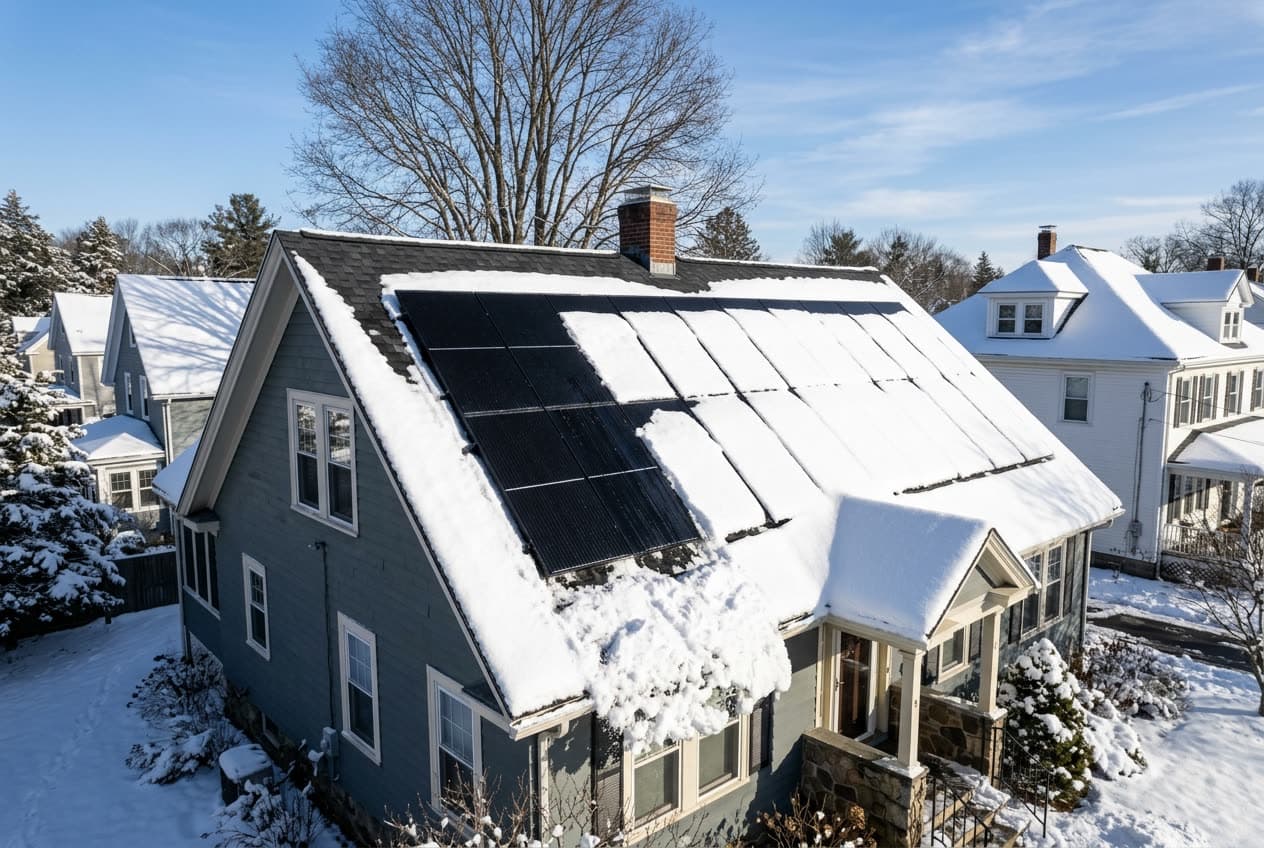
Not while they're buried. A thick layer of snow blocks the light, so production pauses until the snow melts or slides off. Nothing is harmed, and the panels pick back up once the glass is clear.
That pause is usually short. The Department of Energy notes that most snow melts quickly off solar panels or is blown off by wind. Panels are tilted, and once sunlight reaches the dark glass, the snow tends to slide off in a sheet. A light dusting lets some light through.
You usually don't need to do anything about it. Our article on solar panels and snow covers when clearing is worth it and how to do it safely from the ground.
Why does the whole year matter more than any one day?
Because your system is designed for the year, not for a single day. Long spring and summer days often produce more than your home uses. The extra power goes to the grid, and your utility credits you for it.
In Massachusetts and Rhode Island, that happens through net metering. Credits from sunny months carry forward on your bill and help cover the darker months. Connecticut handles this through its own program, RRES, under which homeowners choose either bill credits for the power they send to the grid or compensation for all the power the system makes. Either way, the year evens out.
That's why a gray week or a snowy stretch rarely shows up as a big jump on your bill. Our article on your electric bill with solar panels explains why the bill changes from summer to winter.
Is solar worth it with New England weather?
For many homes, yes. New England gets less sun than the Southwest, but each kilowatt-hour your panels make here replaces power that costs more than in most of the country.
The numbers show the gap. According to the U.S. Energy Information Administration, Rhode Island homes paid an average of 28.29 cents per kilowatt-hour in July 2026, compared with 18.31 cents for the U.S. as a whole. Massachusetts residents pay over 85% more for electricity than the national average. When power is that expensive, the solar your panels make in winter and on cloudy days is still worth a lot.
Rates in the region have also climbed fast. Rhode Island electric rates jumped 50% in the last five years, and Massachusetts rates rose about 50% over the same stretch. Every kilowatt-hour your panels make, on a bright day or a gray one, is a kilowatt-hour you don't buy from the utility at those rising rates.
To see what solar would cost and save on your own home, our guide to what solar costs and saves walks through it.
What happens to solar during a winter power outage?
A grid-tied system without a battery shuts off during an outage, even on a sunny day. That keeps it from sending power onto lines that utility crews are repairing, and it restarts on its own when the grid comes back.
If winter storms and outages worry you, a battery is the answer. It stores solar power and keeps key circuits running when the grid goes down. Our guide to solar batteries and backup power covers how it works.
Questions about how solar would handle a New England winter on your roof? Call us at (508) 507-2908, and we'll show you how your system's estimate accounts for local weather.
Frequently asked questions
Do solar panels work on cloudy days?
Yes. Most panels keep producing from the diffuse light that passes through clouds, but at a reduced rate. How much depends on how thick the clouds are. Very little power comes in during heavy rain or thick cloud cover. Sunnier days and net metering credits from earlier in the year help make up the difference.
Do solar panels work in snow?
Not while they're covered. A thick layer of snow blocks the light, so production pauses until the snow melts or slides off. Panels are tilted and their dark glass warms in the sun, so they usually clear soon after a storm. A light dusting lets some light through, and wind often blows it away.
Are solar panels less efficient in cold weather?
No. Cold doesn't make panels less efficient. The Department of Energy notes that solar cells generally work best at low temperatures, and that panels lose voltage as temperatures climb above about 77 degrees Fahrenheit. Panels make less power in winter because days are shorter and the sun is lower, not because of the cold.
Do solar panels work at night?
No. Panels need daylight to make electricity, so they stop producing after sunset. With net metering, your home draws power from the grid at night and the credits your panels earned during the day help pay for it. A home battery can also store daytime solar power to use in the evening or during an outage.
Your next step
See what solar would do for your home
We design a system for your roof and show you the numbers for every way to pay. Free, with no pressure.
Get my free solar quoteKeep reading
How we wrote this
This page was written by the Evergreen Solar team, which designs and installs home solar across Massachusetts, Rhode Island, Connecticut, New Jersey and Pennsylvania. Program rules and rates change, so we check every figure against the primary source listed below and note the date we last did. If something has changed, tell us at our contact page.
Sources
- U.S. Department of Energy: Solar photovoltaic performance and efficiency basics
- U.S. Department of Energy (FEMP): Solar photovoltaic hardening for resilience, winter weather
- U.S. Department of Energy: Forrestal Building rooftop solar fact sheet (Sept. 9, 2008)
- U.S. Energy Information Administration: Electric Power Monthly, Table 5.6.A (average price by state)
- Eversource: Massachusetts net metering FAQ
- Connecticut PURA: RRES Year 5 decision, Docket 25-08-02 (Dec. 17, 2025)