Key takeaways
- There's no single best solar panel brand for every home. Panels sold for U.S. homes are tested to the same safety standards, so the useful comparison is model to model: wattage, efficiency, how the panel handles heat, both warranties and the company behind them. The design and installation matter more than the label.
- Compare the exact model number on every quote, not just the brand name. One manufacturer can sell several panel lines with different wattage, efficiency and warranty terms. Ask for the datasheet and the warranty document for that model, then line up the same details side by side across your quotes.
- Solar panels usually come with two warranties. The product warranty covers defects in the panel itself. The performance warranty promises the panel will still make a set share of its rated output after a set number of years. Check the length of each, and ask who handles a claim if something fails.
- Evergreen Solar installs Tier 1 rated panels, and every package includes a 25-year comprehensive solar warranty and a 25-year power production guarantee. That coverage is part of the package, not the panel brand, which is one reason the company installing your system matters as much as the panels on your roof.
Once quotes start arriving, the panel brand is often the first thing homeowners look up. It's a natural place to start, and it's easy to go down a rabbit hole of rankings and reviews.
This article shows what actually separates one panel from another and how to compare them on your own quotes. For how the whole system fits together, start with our guide to how home solar works.
Is there a single best solar panel brand?
No. Panels installed on U.S. homes have to pass the same required safety testing, and the gaps between established manufacturers are often smaller than rankings make them look. The right panel depends on your roof, your energy use and the warranty behind it.
What differs is the specific model. One manufacturer may sell several panel lines with different wattage, efficiency and warranty terms. So a fair comparison is model to model, not brand to brand. Ask every company for the exact model number on its quote, plus the datasheet and the warranty document for that model.
Then compare the panels the way you'd compare anything you plan to own for decades: what it does, how it holds up, and who stands behind it.
What should you compare between solar panels?
These are the details worth lining up on every quote. Most come straight off the datasheet.
| What to check | Where to find it | Why it matters |
|---|---|---|
| Exact model number | The quote and the datasheet | Brands sell several lines with different specs and warranties |
| Wattage | Datasheet | Higher wattage means fewer panels for the same system size |
| Efficiency | Datasheet | Matters most when roof space is tight |
| Temperature coefficient | Datasheet | Shows how much output drops as the panel heats up |
| Product warranty | Warranty document | Covers defects in the panel itself |
| Performance warranty | Warranty document | Promises a share of rated output over time |
| Safety listing | Datasheet and panel label | Shows the panel passed required safety testing |
| Who handles claims | Ask the installer | Decides how easy a repair is years from now |
You don't need to become an expert in any of these. You just need the same facts from every company, so you're comparing like with like. Our guide to comparing solar quotes shows where the panels fit among everything else on a quote.
How do wattage, efficiency and heat affect your choice?
Wattage is how much power a panel is rated to make under standard test conditions. A higher-wattage panel makes more each, so a system of the same size needs fewer of them. That helps on a smaller roof or one broken up by vents, dormers and chimneys.
Efficiency is the share of the sunlight hitting a panel that it turns into electricity. It matters most when roof space is tight. On a roof with plenty of good space, a slightly less efficient panel can do the same job, so don't pay extra for efficiency your roof doesn't need.
Temperature coefficient is the spec most people skip. The Department of Energy notes that solar cells generally work best at low temperatures, and much of the sunlight that hits a panel turns into heat. As a panel warms up, its output drops a little. The datasheet lists that drop as a percentage per degree. A number closer to zero means the panel loses less power on a hot summer afternoon.
None of these specs tells you how much a whole system will produce on your roof. That depends on the design, which is why Evergreen Solar's engineering team works it out for each home in its own design software.
What do solar panel warranties cover?
Most panels come with two separate warranties, and it's worth reading both.
- The product warranty covers defects in the panel itself, such as problems with materials or how it was made.
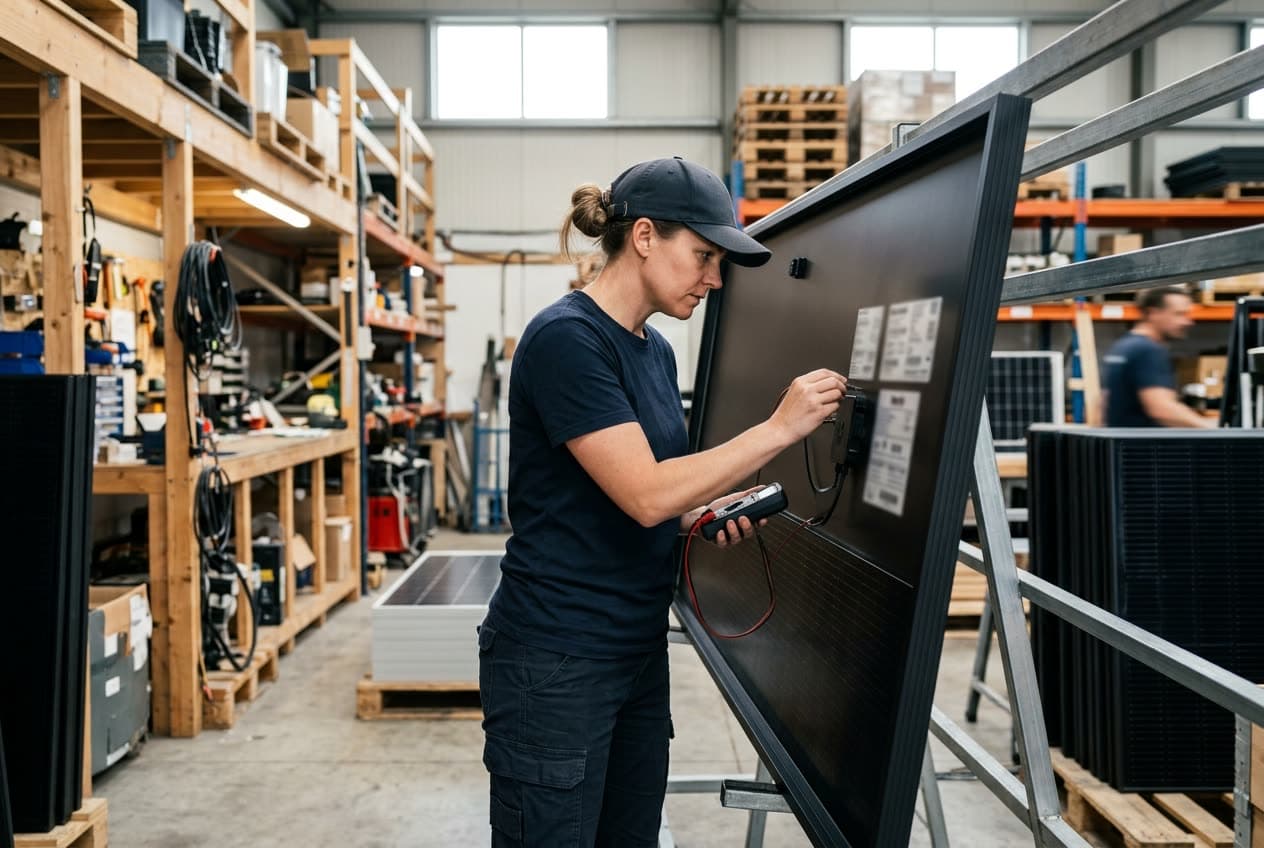
- The performance warranty (also called a power output warranty) promises the panel will still make at least a set share of its rated output after a set number of years. Panels lose output very slowly as they age, and this warranty covers a panel that loses it faster than promised.
The two terms aren't always the same length, so check the number of years on each, and the share of output promised at the end. Then read the fine print on what a claim covers, and ask whether it includes the labor to remove and replace a panel or only the panel itself.
Inverters carry their own warranties, often on different terms. Our article on what a solar inverter does explains that part of the system.
Why does the company behind the panel matter?
A 25-year warranty is only as good as the company that has to honor it. A manufacturer with a long track record and a real presence in the U.S. market is easier to reach years from now than one that may not be around. That's why installers talk about using established, Tier 1 rated manufacturers.
Tier 1 is a label from BloombergNEF, a research firm, for panel makers whose panels banks have recently financed on large projects. It's a sign a manufacturer is established, not a quality grade, and the list changes every quarter. Treat it as a starting filter, then look at the model and the warranties.
Just as important is who handles a claim. If a panel fails, will your installer diagnose it, file the claim and swap the panel? Or will you be on the phone with the manufacturer yourself? Ask before you sign.
Check the safety listing too. U.S. electrical codes require panels to be listed by a nationally recognized testing laboratory, and new panels are evaluated to UL 61730, the U.S. version of the international panel safety standard. Many datasheets also list IEC 61215, a set of design and durability tests for panels meant for long-term outdoor use. Passing those tests is a baseline, not a prediction of how long a panel will last.
Do looks and where panels are made matter?
Looks are a fair thing to care about, since the panels will be on your roof for decades. All-black panels use a black frame and black backing, so they blend in with darker shingles. Others show white lines between the cells or a silver frame. Ask to see a photo of the exact model.
Where panels are made can matter too, mostly for leases and PPAs. American-made equipment can help a system qualify for an extra federal bonus, which can mean a better rate for you. Ask whether the panels on your quote affect the price or the rate. Our article on solar leases vs. PPAs explains how those options work.
Why does the installation matter more than the brand?
A good panel can't make up for a poor design or a sloppy install. Where the panels sit on the roof, how shade is handled, which inverters are used and how carefully the roof is sealed all affect how much power you get and how the system holds up.
The inverter choice is a good example. With microinverters, each panel works on its own, so one shaded panel doesn't drag down the rest. Our comparison of micro-inverters and string inverters explains the trade-offs.
The same goes for the roof work. Racking that's attached to the rafters and flashed properly keeps water out for decades, no matter whose name is on the panels. Ask every company how it mounts the panels and seals the roof, and who comes back if a leak ever shows up.
Our guide on how to choose a solar installer covers what to look for in the company itself. Want to see which panels would fit your roof? Call us at (508) 507-2908, and we'll walk you through the exact model, its datasheet and both warranties.
Frequently asked questions
What is the best solar panel brand for a home?
There isn't one brand that's best for every home. The right panel depends on your roof space, your energy use, your budget and the warranty behind it. Compare the exact model on each quote by wattage, efficiency, temperature coefficient and warranty terms, and weigh the installer's design and workmanship at least as heavily as the brand.
Are more efficient solar panels always better?
Not always. Efficiency is the share of sunlight a panel turns into electricity, and it matters most when roof space is tight, because each panel makes more power from the same area. On a roof with plenty of good space, a slightly less efficient panel can do the same job and be the better value.
What does the temperature coefficient on a solar panel mean?
It tells you how much a panel's output drops as the panel heats up. Solar cells work best when they're cool, and a sunny roof gets hot in summer. The coefficient is listed on the datasheet as a percentage per degree. A number closer to zero means the panel loses less power on hot days.
Should I choose a solar company based on the panel brand?
No. The brand is one line on the quote. The company decides how many panels go on your roof, where they sit, which inverters they use and how carefully everything is wired and sealed. It also stands behind the work for decades. Choose the installer first, then make sure the equipment it offers checks out.
Your next step
See what solar would do for your home
We design a system for your roof and show you the numbers for every way to pay. Free, with no pressure.
Get my free solar quoteKeep reading
How we wrote this
This page was written by the Evergreen Solar team, which designs and installs home solar across Massachusetts, Rhode Island, Connecticut, New Jersey and Pennsylvania. Program rules and rates change, so we check every figure against the primary source listed below and note the date we last did. If something has changed, tell us at our contact page.
Sources
- UL Solutions: UL 1703 and UL 61730 PV module safety standards, making the transition (Sept 5, 2023)
- IEC 61215-1:2021, Terrestrial PV modules: design qualification and type approval
- U.S. Department of Energy: Solar Performance and Efficiency
- IAEI Magazine: PV Modules, Part 1, What the AHJ Needs to Know (Aug 2017)
- Eide Bailly: OBBB energy credits (domestic content bonus under 48E), Aug 26, 2025