Key takeaways
- Tier 1 is a label from BloombergNEF, a research firm, for solar panel makers whose own-brand panels went into at least six large projects financed by six different commercial banks in the past two years. It measures bankability, meaning lenders have accepted the panels. It is not a test of panel quality.
- BloombergNEF says its Tier 1 list should not be used as a measure of quality and doesn't directly reflect a manufacturer's financial strength. The list is updated every quarter, a company can drop off at any time, and only paying subscribers can see the current version. Treat it as one data point, not a grade.
- Instead of relying on a Tier 1 label, ask for the exact panel model, its datasheet and safety listing, the product and performance warranty terms, and who handles a claim. Evergreen Solar installs Tier 1 rated panels and backs every package with a 25-year comprehensive solar warranty and a 25-year power production guarantee.
"Tier 1 panels" shows up on a lot of solar quotes and websites, including ours. It sounds like a quality grade, and many people read it that way. It actually means something narrower, and knowing what helps you ask better questions about the equipment you're buying.
This article explains the label in plain terms. For how panels fit into the rest of a system, see our guide to how home solar works.
What does Tier 1 mean for solar panels?
The term comes from BloombergNEF (BNEF), the energy research arm of Bloomberg. BNEF keeps a list of solar panel makers it calls Tier 1, based on one question: have banks been willing to lend money to large solar projects that use this company's panels? The industry calls that bankability.
BNEF explains why it built the list: clients kept asking for a list of major or "bankable" suppliers. People across the industry talked about Tier 1 companies, but the term was rarely defined. BNEF's list gave it a specific meaning, based on financing deals rather than opinions.
According to BNEF's published methodology, a manufacturer makes the list when:
- It makes panels in its own factories and sells them under its own brand.
- Its panels went into at least six different projects, financed by six different commercial banks, in the past two years.
- Each of those financings was for a project over 10 megawatts, which is utility scale, far larger than any home system.
The financing has to be non-recourse, meaning the bank is repaid from the project itself. In effect, the bank is betting that the panels will hold up. BNEF tracks these deals from public information and publishes a fresh list every quarter.
Is Tier 1 a measure of solar panel quality?
No, and BNEF says so directly. Its methodology calls the classification purely a measure of industry acceptance. It doesn't directly account for product quality or a manufacturer's financial strength, and BNEF notes that there are many documented cases of Tier 1 manufacturers having quality problems or going bankrupt.
BNEF also strongly recommends that buyers and banks not use the list as a measure of quality. It says the list isn't a recommendation of any company or product, and BNEF doesn't test the panels itself. Large buyers who want to judge quality hire technical firms to inspect factories and test samples.
A few other things worth knowing:
- It rates companies, not panels. The label says nothing about the specs of any one model.
- It changes every quarter. A company can be removed in any quarter, so only the latest list counts.
- There is no BNEF Tier 2 or Tier 3. BNEF publishes a Tier 1 list only.
- The list is for subscribers. BNEF warns that copies posted online may have been altered, and that company press releases aren't proof a maker meets its criteria.
What does Tier 1 tell a homeowner?
It tells you something real, just limited. A Tier 1 maker's panels were recently chosen for large projects that lenders were willing to finance, and those lenders usually do their own review of the equipment before they commit. That suggests the company is established in the market rather than a newcomer with no track record.
That matters for a purchase you'll live with for decades. Panel warranties are meant to last for decades, and a warranty is only as good as the company that has to honor it. A manufacturer that large projects keep choosing is more likely to still be selling panels later than one nobody has heard of.
But "more likely" isn't a promise. Since BNEF doesn't measure financial strength, Tier 1 can't tell you a company will be around in 20 years. That's one reason the installer's own warranty matters as much as the panel maker's.
Tier 1 also leaves out the things that decide how a panel works on your home:
- The wattage and efficiency of the model on your quote, and whether it suits the space on your roof.
- How much output the panel loses on hot days, which the datasheet lists as its temperature coefficient.
- How long the product and performance warranties last, and what a claim covers.
- Whether the panel matches the look you want, such as an all-black design.
A manufacturer can sell several panel lines, and the label covers all of them equally. The model number is where the real comparison starts.
Why do solar installers talk about Tier 1 panels?
Because it's a quick, recognized way to say an installer sticks with established manufacturers. Most homeowners don't want to research panel makers one by one, and the label gives a simple starting point.
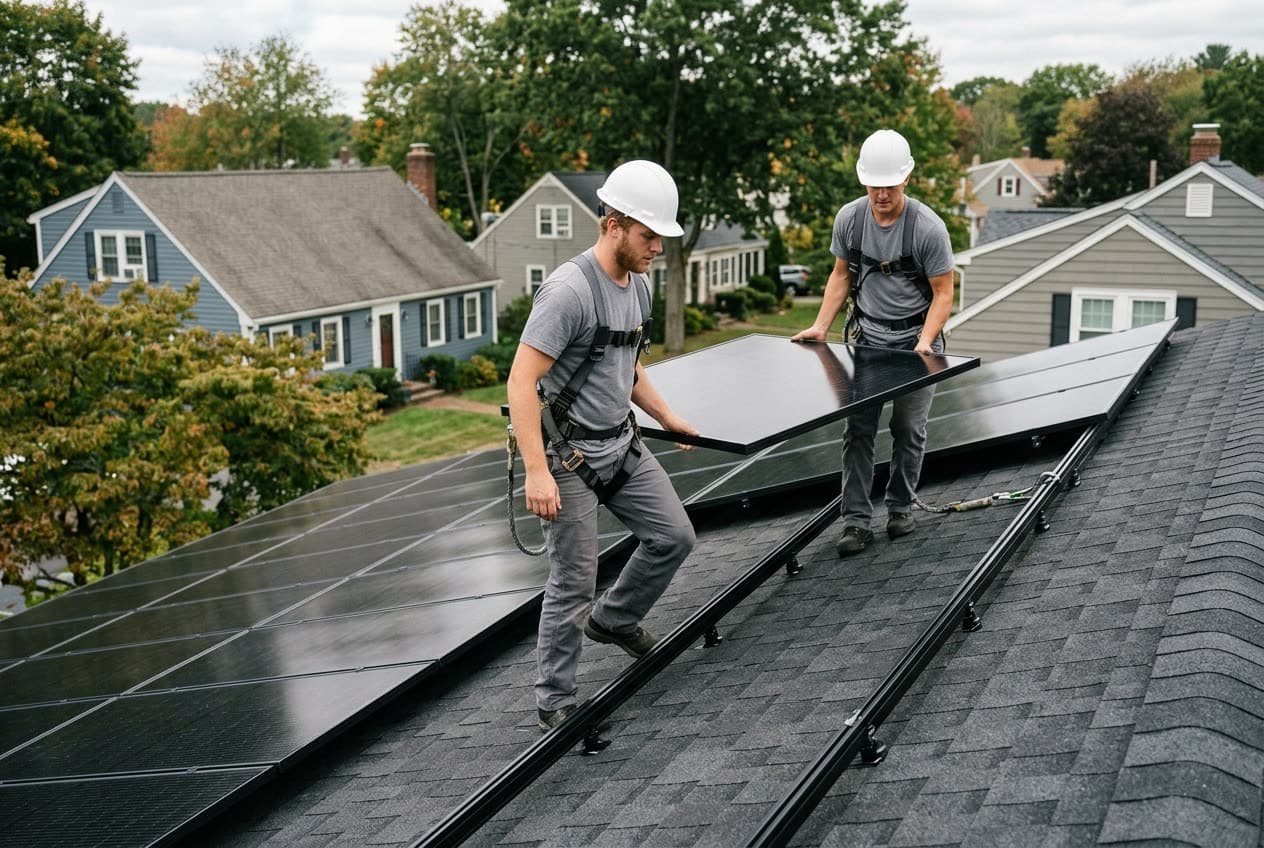
Evergreen Solar installs Tier 1 rated panels. In plain terms, that means we choose panels from manufacturers that are established in the market. It isn't a separate certification, and it isn't a warranty. And because the list changes every quarter, it describes a manufacturer at a point in time, not forever. The protection you actually rely on comes from the warranties on the panels and the coverage your installer provides.
Standard in every Evergreen Solar package
Tier 1 rated solar panels, a 25-year comprehensive solar warranty and a 25-year power production guarantee. Whichever installer you choose, ask what it covers itself, beyond the panel maker's warranty, and how long that coverage lasts.
What should you ask about the panels in your quote?
These questions tell you far more than a Tier 1 label:
- What is the exact panel model? Ask for the model number and the datasheet, not just the brand.
- Is it safety listed? New panels in the U.S. are evaluated to UL 61730, the U.S. version of the international panel safety standard. Many datasheets also list IEC 61215, a set of design and durability tests for panels meant for long-term outdoor use.
- What do the warranties cover? Ask for the product warranty, which covers defects, and the performance warranty, which promises a share of rated output over time. Check the years on each.
- Who handles a claim? Will the installer diagnose a problem and deal with the manufacturer, or will you?
- What does the installer guarantee? Ask about the installer's own warranty and any production guarantee, and how long each lasts.
Then look past the panels. The design decides where panels sit on your roof and how shade is handled, and the inverters decide how the panels work together. Our comparison of micro-inverters and string inverters explains one of the biggest equipment choices on a quote.
Should Tier 1 decide which solar quote you pick?
No. It's a reasonable thing to see on a quote, but it's one data point. Two quotes can both promise Tier 1 panels and still differ a lot in design, inverters, warranties and the company standing behind the work. A well-designed system with solid panels, installed carefully by a company that answers the phone years later, is what keeps your system producing.
Line up the details that affect you directly instead. Our guide to comparing solar quotes walks through them, and our article on choosing a solar installer covers the company itself.
Want to know exactly which panels would go on your roof? Call us at (508) 507-2908. We'll share the model, its datasheet and both warranties, along with the coverage that comes with every Evergreen Solar package.
Frequently asked questions
Who decides which solar panels are Tier 1?
BloombergNEF (BNEF), the energy research arm of Bloomberg, publishes the best-known Tier 1 list of solar panel makers. It updates the list every quarter based on its database of financed solar projects. Strictly speaking, the label applies to manufacturers, not individual panels, so it says nothing about any one model's specs.
Are there Tier 2 and Tier 3 solar panels?
Not from BloombergNEF. Its methodology says it maintains a Tier 1 list only and doesn't publish a Tier 2 or Tier 3 list. When you see those terms on a website or in a sales pitch, they're informal labels, not part of BloombergNEF's system.
Can I see the current Tier 1 solar panel list?
Not for free. BloombergNEF shares the list only with its subscribers, and it warns that copies posted online may break its license terms or may have been altered. It also says press releases and company claims aren't proof that a maker meets its criteria. Ask your installer for the exact model and datasheet instead.
Does a Tier 1 panel come with a better warranty?
Not necessarily. Tier 1 status has nothing to do with warranty terms. Each panel model has its own product warranty and performance warranty, and they vary between manufacturers and panel lines. Read the warranty document for the exact model on your quote, and ask what your installer covers on top of it.
Your next step
See what solar would do for your home
We design a system for your roof and show you the numbers for every way to pay. Free, with no pressure.
Get my free solar quoteKeep reading
How we wrote this
This page was written by the Evergreen Solar team, which designs and installs home solar across Massachusetts, Rhode Island, Connecticut, New Jersey and Pennsylvania. Program rules and rates change, so we check every figure against the primary source listed below and note the date we last did. If something has changed, tell us at our contact page.