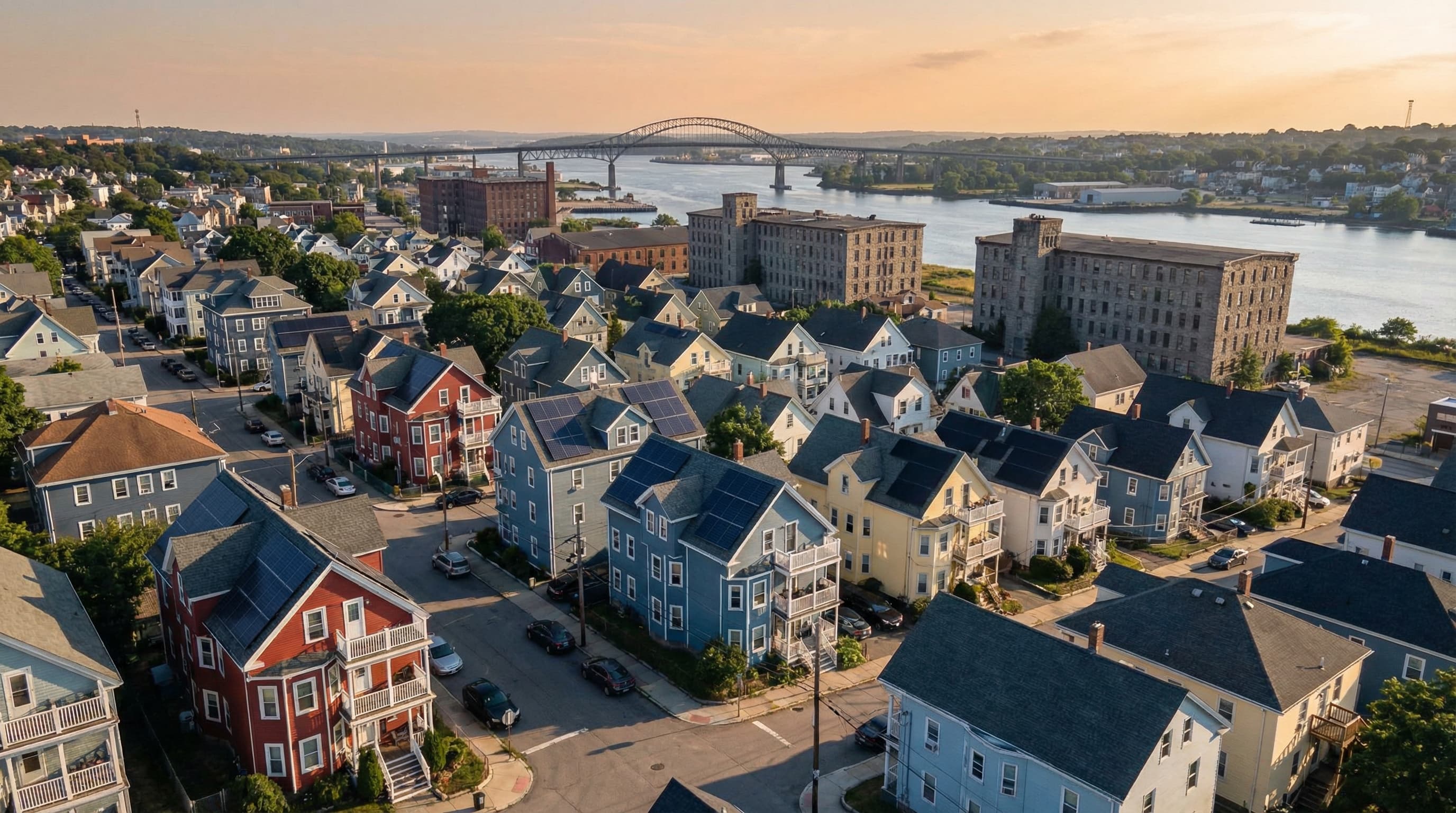
Fall River Solar: Affordable Energy for a Working City
Fall River’s affordable installation costs and high Eversource rates make solar one of the smartest moves a homeowner here can make.
See Fall River PricingThe Real Cost of Going Solar in Fall River
Fall River homeowners deal with the same steep Eversource rates as the rest of southeastern Massachusetts — about 29 cents per kWh — but they get a break on installation costs. Solar in Fall River averages about $3.00 per watt before incentives, tied with Springfield for the lowest among major Massachusetts cities. The city’s housing stock plays a role: neighborhoods like the Highlands, Maplewood, and South End have homes with spacious, pitched roofs that are straightforward to install on, keeping labor costs down.
For a city where the median household income is around $45,000 and the median home value is about $310,000, every dollar saved matters. Solar eliminates the uncertainty of Eversource rate hikes and replaces it with a fixed payment that is typically 30–40% lower than your current bill. With $0-down options available, you do not need savings in the bank to start saving on energy.
Solar System Costs by Size
| System Size | Gross Cost | Federal Credit | State Incentive | Net Cost |
|---|---|---|---|---|
| 5kW | $15,000 | $4,500 | $1,500 | $9,000 |
| 7kW | $21,000 | $6,300 | $2,100 | $12,600 |
| 10kW | $30,000 | $9,000 | $3,000 | $18,000 |
Fall River Incentives That Slash Your Solar Cost
Fall River homeowners access the full Massachusetts incentive package, and with the lowest base costs in the state, those incentives cover a huge percentage of the total. The 30% federal tax credit saves $6,300 on a 7 kW system. MREC payments deliver about $300 per year for 25 years — $7,500 over the life of the program. The sales tax exemption saves $1,310, and the property tax exemption means your home’s value increases without a penny of extra property tax.
Like neighboring New Bedford, parts of Fall River are designated as an energy community, which may qualify some homeowners for an additional 10% federal tax credit bonus. That would bring the total federal credit to 40% — saving an additional $2,100 on a 7 kW system and pushing the net cost below $10,500. For Fall River families watching every dollar, that bonus can make the difference between going solar and continuing to overpay Eversource.
Eversource Rates in Fall River: The Bill That Never Stops Growing
Eversource charges Fall River residential customers around 29 cents per kWh for total delivered electricity. A typical Fall River home using 700 kWh per month pays about $200 to Eversource — over $2,400 per year. Five years ago, that same usage would have cost roughly $1,600. That is a 50% increase in just half a decade, and the trend shows no signs of reversing.
Solar gives Fall River homeowners something Eversource never will: a fixed rate. Whether rates go up 3% next year or 15%, your solar payment stays the same. Over 25 years, that predictability is worth as much as the raw savings. In a city where most families live on tight budgets, knowing exactly what your energy costs will be next month — and next decade — is genuinely life-changing.
25-Year Solar ROI for a Fall River Home
A typical three-decker or single-family in the Highlands using 8,200 kWh per year pays Eversource about $2,378 annually. A $0-down solar lease at $125 per month — $1,500 per year — saves $878 in year one. With Eversource raising rates 3–5% annually, second-year savings jump to over $950, and the gap keeps growing.
Over 25 years, a leased system saves a typical Fall River homeowner over $40,000 in cumulative electricity costs. Buy the system outright at a net cost of $12,600 (or as low as $10,500 with the energy community bonus), and payback comes in 5 to 6 years. After that, you generate free electricity for 19+ years, with total lifetime savings of $55,000 to $70,000. On a $310,000 home, the added property value of $15,000–$20,000 represents a 5–6% equity boost — tax-free, thanks to the Massachusetts property tax exemption.
Frequently Asked Questions
✶How much do solar panels cost in Fall River?+
✶Is Fall River an energy community for the solar tax credit?+
✶What is the solar payback period in Fall River?+
✶Can I afford solar in Fall River with a modest income?+
✶How much will I save on my Eversource bill with solar in Fall River?+
✶Are three-deckers in Fall River good for solar?+

Fall River Eversource Bills Keep Climbing
Eversource rates have risen over 50% in the last 5 years. Fall River homeowners are locking in lower rates with solar.
See How Much You Can SaveWhat’s Really on Your Eversource Bill?
57% of your bill is hidden fees and charges!
Delivery Charges
Hidden charges like "customer charge" and "energy efficiency surcharge" that inflate your Eversource bill every month.
17%
of your bill
Distribution
Covers infrastructure delivering electricity from the main lines to your Fall River home.
27%
of your bill
Transmission
Eversource’s charge for transporting power from generation facilities to your local grid.
13%
of your bill
Actual Supply
The electricity you actually use—just 43% of what you pay.
43%
of your bill
Solar Eliminates All These Charges
When you go solar, you no longer rely on the utility company to produce electricity—and no longer have to pay their ridiculous charges. Instead, you produce your own power with a low, locked-in solar rate.
Eliminate Your Electric Bill TodayIs Solar Really Free in Fall River?
While solar panels are not technically “free,” you pay less for solar than you already pay Eversource — and it costs nothing to switch.
You trade an unpredictable Eversource bill for a fixed solar payment that is about 40% lower. For Fall River families, that savings hits different.

Need a New Roof? Bundle and Save.
Our Roof + Solar Bundle lets Fall River homeowners get a new roof and solar together. Save by bundling — and pay less than Eversource.
Learn About Roof + SolarSee What Solar Costs for Your Fall River Home
Get a free, personalized quote based on your roof, Eversource usage, and all available incentives — including the energy community bonus. No cost, no obligation.
Get Your Free Quote