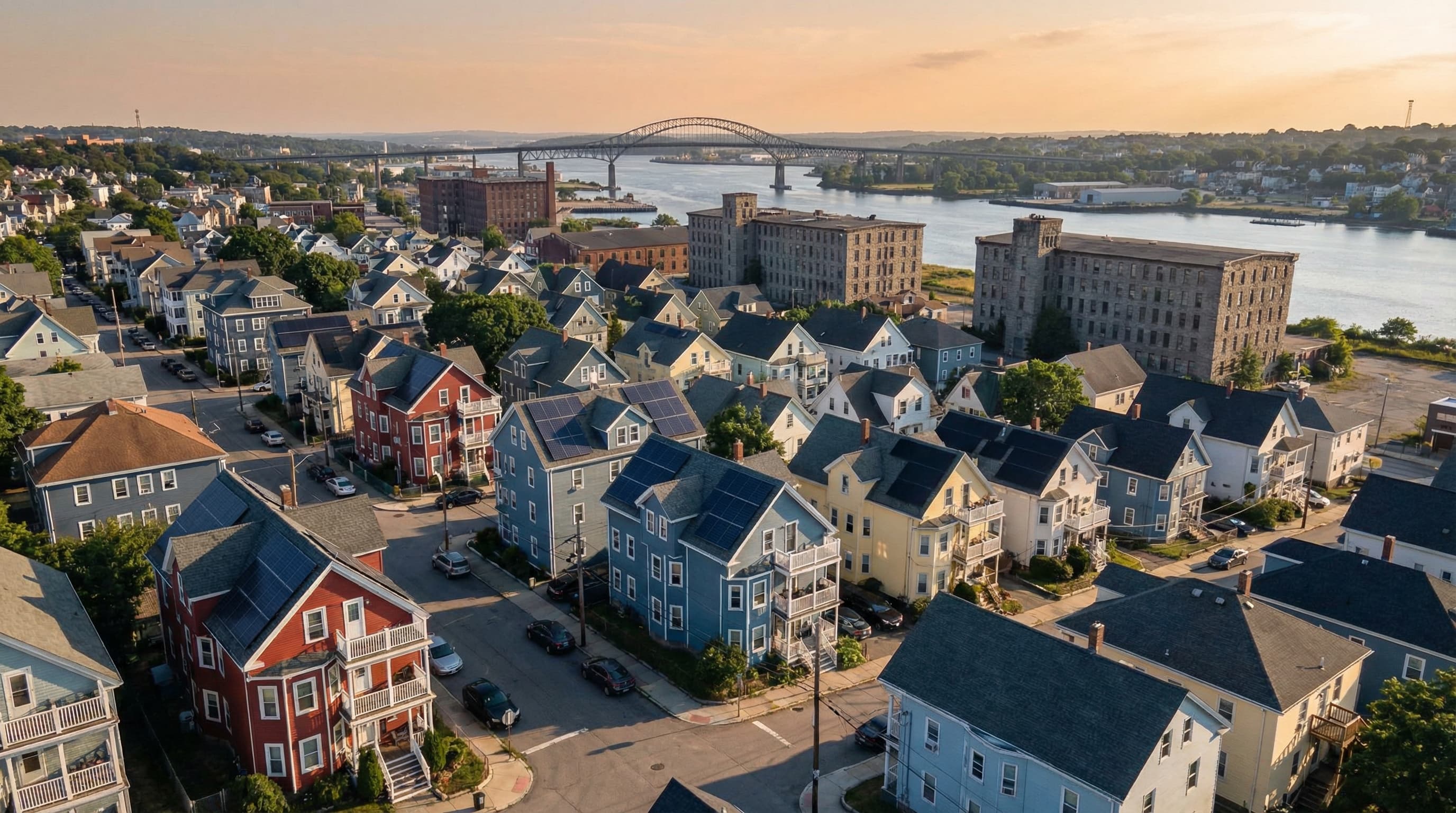
Fall River: The Mill City Powered by the Sun
With average electric bills hitting $334 per month, Fall River homeowners have every reason to switch to solar.
See Your SavingsWhy Fall River’s Electric Bills Are Pushing Homeowners to Solar
Fall River knows what it means to adapt. The city that once powered America’s textile industry is now watching its residents power their own homes with solar. And with good reason — the average Fall River residential electric bill is around $334 per month, driven by National Grid rates that keep climbing. Supply charges hit 15.4 cents per kWh in February 2026, and that’s before delivery charges nearly double the total. Homeowners in The Flint, Maplewood, and Globe Corners are tired of writing those checks.
Fall River is part of the MASS CEA buying group — a coalition of 25 municipalities that negotiates group electricity rates — with a 100% renewable energy option available. But solar goes further: you generate your own power, earn net metering credits from National Grid, collect MREC payments for 25 years, and lock in a rate that’s about 40% lower than what you’re paying now.
$334
Average Monthly Electric Bill
$0
Upfront Cost
40%
Lower Monthly Payment
Federal Solar Tax Credit for Fall River Homeowners
Fall River homeowners served by National Grid benefit from the federal solar tax credit, which delivers significant savings on solar installations. Through solar leases and PPAs, the value of this credit is automatically applied to your plan — no tax paperwork, no out-of-pocket expense. You simply get a lower monthly payment from day one.
For Fall River families dealing with $334 average monthly electric bills, the federal credit is a game-changer. It brings the monthly solar payment well below what National Grid charges, putting real money back in your pocket every single month.
How Massachusetts Programs Work in Fall River
Fall River residents access every Massachusetts solar incentive, and with some of the highest electric bills in the state, the payoff is substantial. The MREC program pays you for every kilowatt-hour your panels generate for 25 years. The property tax exemption protects your home’s increased value from higher taxes. And the 6.25% sales tax exemption saves thousands on the system purchase.
The Mass Solar Loan Program provides low-interest financing for homeowners who prefer to buy outright. Fall River’s MASS CEA membership already shows the city is proactive about energy costs, and solar is the next logical step. Community solar options are also available through the Eversource Community Solar Access Program for low-income residents in the area.
$334/Month Is Too Much for Electricity
The average Fall River household pays $334 per month for electricity from National Grid. Solar cuts that by roughly 40% — saving you over $130 every month, or more than $1,600 per year, starting immediately.
National Grid Net Metering in Fall River
National Grid provides net metering for all residential solar customers in Fall River. When your panels produce more electricity than your home consumes, the excess goes back to the grid and you earn credits on your National Grid bill. Those credits offset your usage during evenings, cloudy days, and the cold Bristol County winters.
Net metering turns the National Grid system into your free battery. Instead of buying home storage for $10,000+, you bank excess production during sunny months and draw on those credits when production dips. Credits roll over month to month, keeping your bill low even during the shortest winter days.
Fall River-Specific Solar Benefits
Property Tax Exemption
Solar increases your Fall River home’s value without raising your property taxes. Tax-free equity in your biggest asset.
National Grid Net Metering
Excess solar energy earns credits on your National Grid bill that roll over month to month. Free grid storage.
MASS CEA Member City
Fall River’s community buying group already negotiates better rates. Solar goes even further — 40% lower than National Grid.
Low-Income Solar Access
Community solar programs offer low-income Fall River residents up to $420 in annual bill savings with no rooftop installation.
What Solar Actually Saves a Fall River Homeowner
A Fall River home with an average $334 monthly electric bill can go solar for $0 upfront and pay approximately 40% less — around $200 per month. That’s $134 back in your pocket every month, or over $1,600 per year. All federal, state, and local incentives are already factored into that lower payment.
Over 25 years, the combined savings from lower monthly payments, MREC credits, and avoided National Grid rate increases can total $50,000 or more for a typical Fall River household. National Grid supply rates have risen over 50% in the past five years — solar locks in your rate and stops the bleeding.
How It Works
Free Consultation
We evaluate your Fall River home, energy usage, and roof to design the right solar system for your property.
Custom System Design
Our engineers create a panel layout optimized for your roof, factoring in Fall River’s SouthCoast weather patterns and local building codes.
Permitting & Approvals
We handle all Fall River building department permits, National Grid interconnection paperwork, and any necessary approvals.
Professional Installation
Our certified installers mount your solar system, typically completing the job in one to two days for a standard residential roof.
Inspection & Activation
After passing Fall River city inspection and receiving National Grid permission to operate, your system goes live and starts saving you money.
Frequently Asked Questions
✶Why are Fall River electric bills so high?+
✶Does National Grid offer net metering in Fall River?+
✶What is the MASS CEA program in Fall River?+
✶Are there solar programs for low-income Fall River residents?+
✶How much can I save with solar in Fall River?+
✶How long does solar permitting take in Fall River?+

$334 a Month to National Grid? There’s a Better Way.
National Grid supply rates jumped 5.5% in 2025. Fall River homeowners can lock in a rate that’s 40% lower with solar.
See How Much You Can SaveWhat’s Really on Your National Grid Bill in Fall River?
57% of your bill is hidden fees and charges!
Delivery Charges
Hidden fees like "customer charge," "energy efficiency surcharge," and "renewable energy charge" pad your National Grid bill beyond the supply cost.
18%
of your bill
Distribution
Covers the poles, wires, and transformers that deliver power to your Fall River home from the main distribution line.
26%
of your bill
Transmission
What National Grid charges for transporting power from generating stations to Fall River’s local grid infrastructure.
13%
of your bill
Actual Supply
The electricity you actually use—just 43% of what you pay.
43%
of your bill
Solar Eliminates All These Charges
When you go solar, you no longer rely on the utility company to produce electricity—and no longer have to pay their ridiculous charges. Instead, you produce your own power with a low, locked-in solar rate.
Eliminate Your Electric Bill TodayIs Solar Really Free in Fall River?
While you can’t technically get “free” solar panels, they are “free” in the sense that you can expect to pay less for solar than you already do for electricity — and it costs nothing to make the switch.
You’re swapping out a $334 National Grid bill for a price-protected solar payment that is usually about 40% lower. That’s $134 a month you keep — every month, for 25 years.

Need a New Roof? Bundle and Save.
Our Roof + Solar Bundle makes it easy for Fall River homeowners to get a new roof and solar at the same time. Many of Fall River’s older mill-era homes benefit from a bundle approach.
Learn About Roof + SolarStop Overpaying National Grid in Fall River
Get a free personalized quote and see how much you can save with solar. With $334 average monthly bills, Fall River homeowners have the most to gain.
Get Your Free Quote