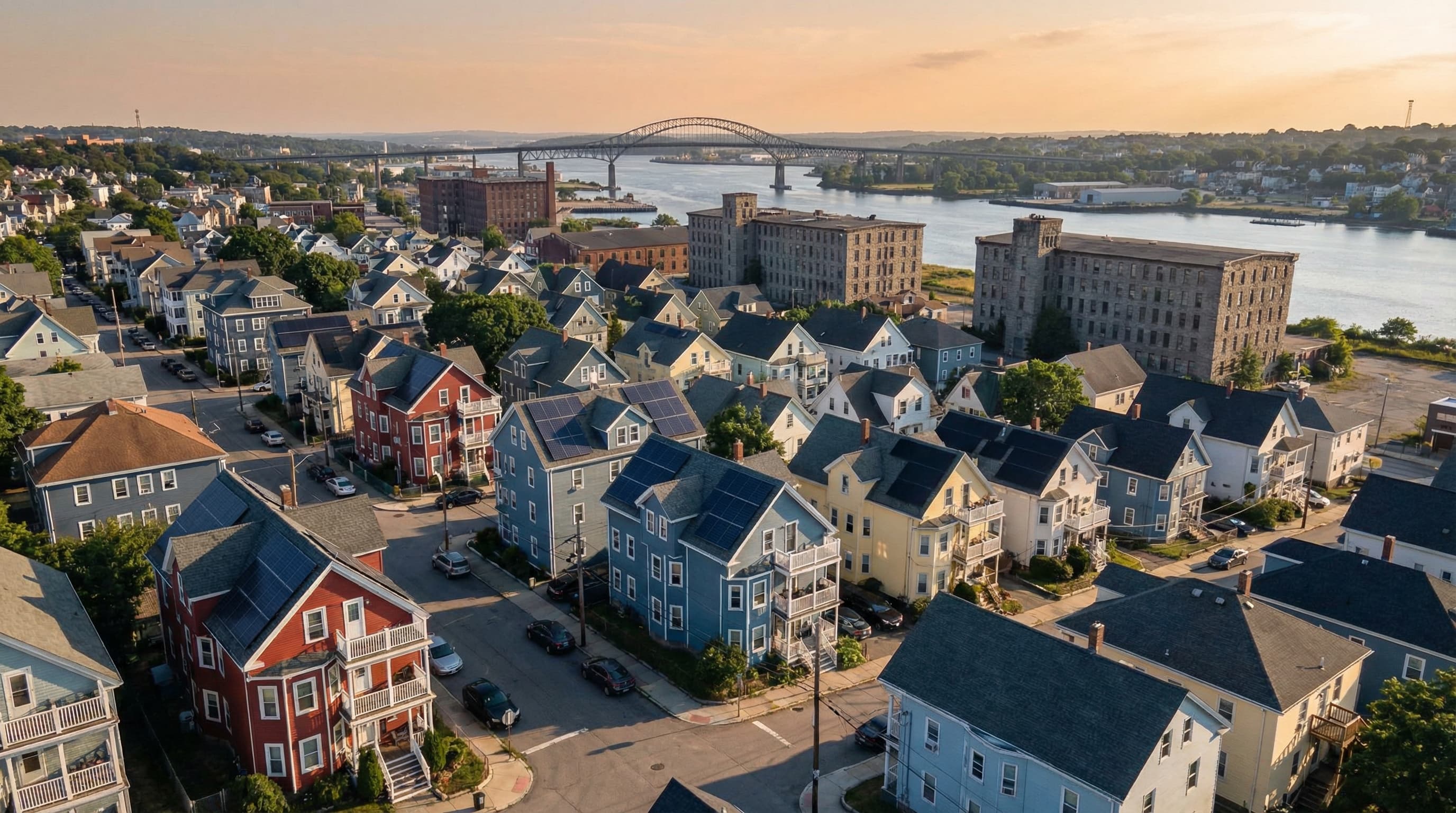
Solar Installation in Fall River
From mill buildings to ranch houses — Fall River is trading its industrial energy past for a solar-powered future.
Get Your Free QuoteSolar in the Scholarship City
Fall River's industrial heritage shaped a city of steep hills, dense neighborhoods, and a housing stock that ranges from 19th-century worker cottages in the Flint and Globe Corners neighborhoods to suburban ranches and split-levels in the North End and Maplewood. The city sits on Mount Hope Bay, giving it both coastal wind exposure and the mild snow loads that come with proximity to the water. Fall River's ground snow load is 30 psf — at the lower end of the Massachusetts range.
Fall River is served by National Grid, which handles electricity delivery and solar interconnection for the city. The local Building Department processes permits, and the city's Community Electricity Aggregation program through MA CEA means residents already have some experience navigating energy choices. Most residential solar installations in Fall River take 3 to 5 months from contract to Permission to Operate — competitive with other South Coast cities.
Installation Process
Site Assessment & Structural Review
An engineer evaluates your roof's orientation, pitch, shading, and load-bearing capacity. Fall River's hilly terrain means roof orientations vary significantly even within the same neighborhood. The structural review accounts for panels plus the city's 30 psf ground snow load and coastal wind exposure.
Fall River Building Permit
Your installer submits building and electrical permit applications to the Fall River Building Department at Government Center. The city follows the state's model solar permitting guidance. Residential solar permits typically take 2 to 4 weeks.
National Grid Interconnection
An interconnection application is filed with National Grid while permits are in progress. National Grid serves Fall River and processes simplified residential applications within 15 to 30 business days under state law. National Grid has a solid track record for timely interconnection in the South Coast region.
Panel Installation
Fall River's residential roofs are predominantly asphalt shingle on pitched frames. Standard flashed rail mounts are the primary installation method. The city's older homes in the Flint, Globe Corners, and Highlands neighborhoods may need rafter reinforcement if framing is undersized for modern load requirements. Most installations take 1 to 2 days.
Inspection & Permission to Operate
A Fall River electrical inspector verifies code compliance. After passing inspection, National Grid schedules a bi-directional meter installation and issues Permission to Operate — typically 2 to 3 weeks later. Then your system goes live and starts generating net metering credits on your National Grid bill.
Fall River Permits: Straightforward Process
Fall River's Building Department processes solar permits efficiently, following the state's model solar permitting guidance. Residential systems typically receive permits within 2 to 4 weeks of application. Both a building permit and an electrical permit are required — your installer handles all applications, structural calculations, and electrical diagrams.
Fall River does not have the extensive historic district overlay that complicates permitting in Boston or Cambridge. While the city has some historically significant properties near the waterfront and in the Highlands, the vast majority of residential installations proceed through standard permitting without additional review layers. After installation, a city electrical inspector visits to verify the system meets code before National Grid processes the meter change.
Fall River Roofs: Hills, Age, and Coastal Winds
Fall River's dramatic topography — the city drops steeply from the highlands to the waterfront — means roof orientations vary dramatically. A home in the North End might have a perfect south-facing slope, while a home on a steep hillside in the Flint neighborhood might face east or west. Detailed site assessment is essential to maximize production. Asphalt shingle roofs are by far the most common, found on everything from compact worker cottages to mid-century ranches.
The age of Fall River's housing stock is the primary consideration. Many homes in the Flint, Globe Corners, and Highlands neighborhoods date to the late 1800s and early 1900s, with roof framing that may not meet current structural code for additional loads. A structural assessment identifies whether sister rafters or other reinforcement are needed before panels go up. Coastal wind exposure from Mount Hope Bay means racking systems are engineered for higher wind speeds — typically 110 to 120 mph design loads in Fall River.
Installation Day in Fall River
Fall River's mix of dense hillside neighborhoods and more spacious suburban areas means the installation experience varies by location. In the compact streets of the Flint and South End, crews may need to park on the street and carry equipment to the house. In the North End, Maplewood, and Somerset-adjacent areas, driveways and larger yards make staging easy.
A typical Fall River installation takes 1 to 2 days. Crews install racking in the morning, mount panels by midday, and complete wiring and inverter connections by end of day. Fall River's relatively mild coastal climate means fewer weather delays than inland cities during the winter installation season. After installation, your system waits for city inspection and National Grid Permission to Operate — usually 2 to 3 weeks — before generating credits on your bill.
Frequently Asked Questions
✶How long does the solar permit process take in Fall River?+
✶Which utility serves Fall River for solar interconnection?+
✶Can older Fall River homes support solar panels?+
✶Does Fall River's hilly terrain affect solar installation?+
✶What is the total timeline for solar installation in Fall River?+

Fall River National Grid Bills Keep Climbing
National Grid rates on the South Coast have risen sharply. Lock in a lower rate today with solar.
See How Much You Can SaveWhat’s Really on Your National Grid Bill?
57% of your bill is hidden fees and charges!
Delivery Charges
Confusing charges like the "customer charge" and "energy efficiency charge" make up most of the hidden fees on your National Grid bill.
17%
of your bill
Distribution
Covers the poles, wires, and infrastructure delivering power to your Fall River home.
27%
of your bill
Transmission
What National Grid charges for transporting power from the supply source to local towers and lines.
13%
of your bill
Actual Supply
The electricity you actually use—just 43% of what you pay.
43%
of your bill
Solar Eliminates All These Charges
When you go solar, you no longer rely on the utility company to produce electricity—and no longer have to pay their ridiculous charges. Instead, you produce your own power with a low, locked-in solar rate.
Eliminate Your Electric Bill TodayIs Solar Really Free in Fall River?
While you can’t technically get “free” solar panels, they are “free” in the sense that you can expect to pay less for solar than you already do for National Grid electricity — and it costs nothing to make the switch.
You’re swapping out an unpredictable and constantly increasing National Grid bill for a price-protected solar payment that is usually about 40% lower.
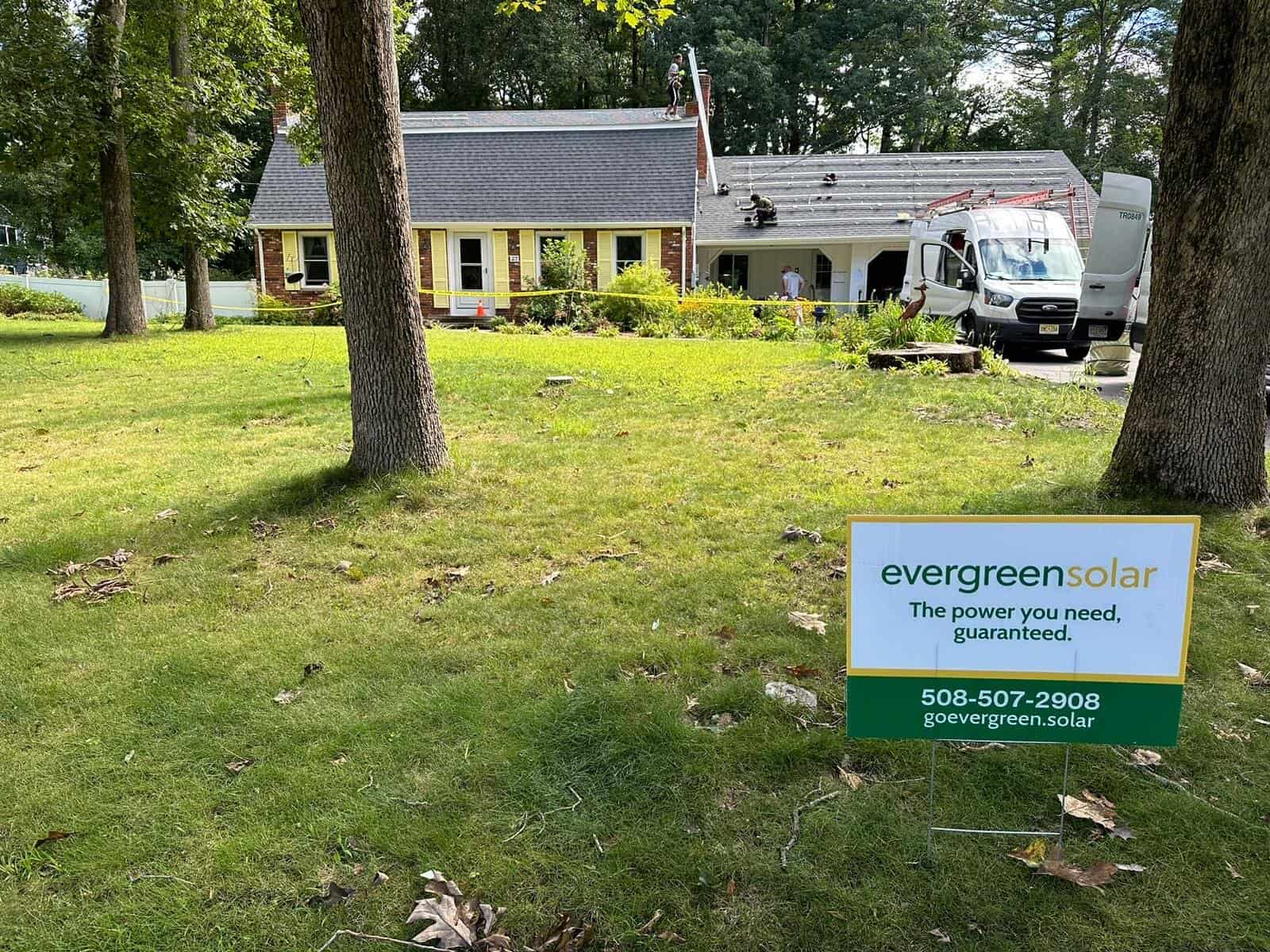
Need a New Roof? Bundle and Save.
Our Roof + Solar Bundle makes it easy for Fall River homeowners to get a new roof and solar at the same time. Since the roof is essential to the solar project, you save big by bundling.
Learn About Roof + SolarReady to Install Solar in Fall River?
Get a free quote from installers who know Fall River's roofs, National Grid's interconnection process, and the South Coast's coastal conditions. We handle everything.
Get Your Free Quote