Key takeaways
- Solar panels installed correctly don't damage your roof or cause leaks. The racking is fastened into the rafters, and each attachment gets metal flashing that slides under the shingles above it, so water runs over the mount instead of into the roof. Sealant is a backup layer, not the main defense.
- When solar panels do leak, the cause is almost always workmanship: a fastener that misses the rafter, flashing that was skipped or installed wrong, sealant used in place of flashing, or shingles cracked during the install. That's why the installer you pick, and the warranty behind the work, matter as much as the panels.
- A typical home solar panel weighs about 45 pounds, spread over about 21 square feet. With the racking, an array usually adds only a few pounds per square foot. Most sound roofs carry that easily, and the installer checks the rafters and local snow loads before the design is final.
- The shingles under an array are shaded from direct sun and covered from some hail and wind-driven rain, which can help that section of roof age more slowly. It's a side benefit, not a fix for a worn roof. If your roof is near the end of its life, replace it as part of the project.
Your roof keeps the weather out, and putting holes in it on purpose feels wrong. That's why "will solar panels damage my roof?" is one of the first questions homeowners ask us.
The honest answer is that a well-installed system doesn't, and a poorly installed one can. This article explains the difference so you can tell which one you're getting. If your worry is your roof warranty, our post on whether solar panels void a roof warranty covers that side.
How do solar panels attach to your roof?
On a shingle roof, a typical installation goes like this:
- Find the rafters. The crew locates the rafters or trusses under the roof deck. The mounts have to go into that framing, not just into the plywood.
- Fasten the mounts. Each mount is secured with lag bolts or structural screws driven into the rafter, at the spacing the design calls for.
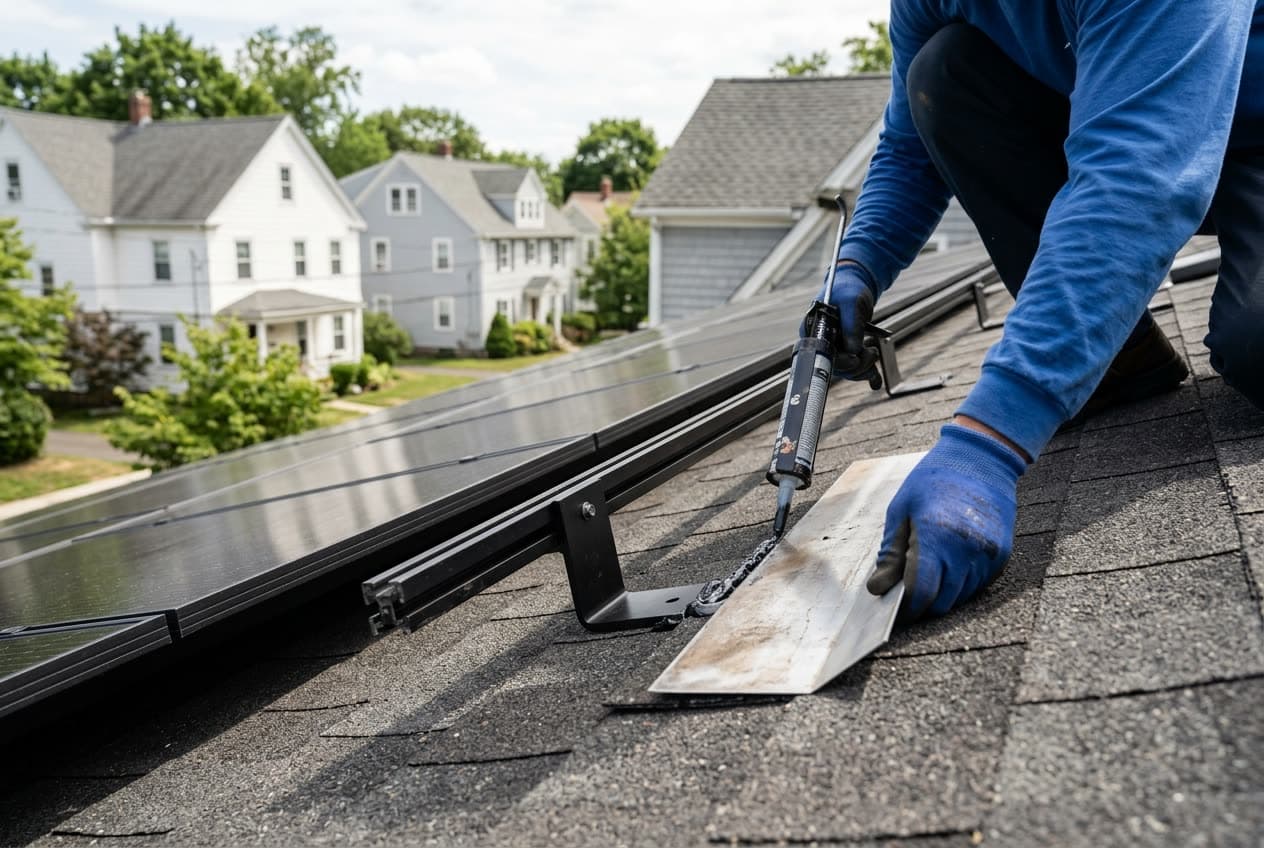
- Flash every attachment. A metal flashing plate slides up under the course of shingles above the mount. Water running down the roof flows over the flashing and back onto the shingles below, the same way it does around a chimney or a vent pipe.
- Seal it. Sealant goes around the fastener and under the flashing as a second layer of protection.
- Add rails and panels. Aluminum rails bolt to the mounts, and the panels clamp to the rails, a few inches above the shingles so water and air move freely underneath.
Other roofs work a little differently. On standing-seam metal, clamps can often grip the raised seams, so the roof isn't drilled at all. The goal is always the same: hold the panels firmly and keep water out.
How many mounts you get isn't a guess. The design sets the spacing from your rafter layout and the wind and snow your roof has to handle, and the plans go to your town with the permit application. That's why a careful installer wants to see your attic, not just a satellite photo of your roof.
Do solar panels cause roof leaks?
Not when they're installed correctly. Building inspectors check for this: California's statewide solar permitting guidebook, for example, lists "roof penetrations/attachments are properly flashed" as an item on its inspection checklist.
When panels do leak, the cause is almost always workmanship, not the panels themselves. Here's what goes wrong, and what a careful crew does instead.
| What goes wrong | Why it leaks | What a careful install does |
|---|---|---|
| Fastener misses the rafter | The screw only grips the roof deck, loosens over time, and leaves an open hole | Locates each rafter first and fills any missed hole properly |
| Flashing skipped or misplaced | Water runs straight into the fastener instead of over it | Slides flashing under the shingle course above every mount |
| Sealant used in place of flashing | Sealant alone breaks down in sun and freeze-thaw cycles | Uses sealant only as a backup to flashing |
| Shingles damaged during the install | Cracked or lifted shingles let water in | Takes care on the roof and replaces any damaged shingles |
Roof condition plays a part too. Shingles that are already brittle or curling are harder to work around without cracking, and flashing only works if the shingles over it are sound. That's one reason a good installer looks closely at the roof before anything is designed, not on installation day.
A leak from a solar install usually shows up as a stain on an attic rafter or a ceiling near the array. If you ever see one, call your installer rather than climbing up to look. Walking on a roof with panels can crack shingles and the panels themselves.
How much do solar panels weigh?
A typical home solar panel weighs about 45 pounds. REC, one major manufacturer, lists its Alpha Pure-R panel at 21.5 kilograms, about 47 pounds, spread over about 21 square feet. That's a little over 2 pounds per square foot for the panel itself.
Racking adds a bit more. As a reference point, California's solar permitting guidebook offers a simplified structural check for rooftop arrays whose panels and mounts together weigh no more than 4 pounds per square foot. The same guidebook assumes an asphalt shingle roof itself weighs about 10 pounds per square foot.
The weight is also spread out. A 20-panel array of panels like that one comes to a bit under 1,000 pounds, but it rests on dozens of mounts across many rafters, not on one spot. Per square foot, that's a small addition to what the roof already carries, which is part of why a sound roof handles it well.
Panel weights vary by brand and size, so your installer works from the spec sheet for the exact panels in your design. If you're curious, ask to see it. The weight is listed right next to the dimensions.
Can your roof support solar panels and snow?
Most roofs in good condition can. Still, your installer should check, not assume. During Evergreen Solar's site survey, we look at the roof, the attic and the home's electrical system. In the attic, that means the rafter size and spacing, the condition of the wood, and any signs of sagging, old leaks or past changes to the framing.
Snow matters here. Your town's building code sets the snow load a roof must carry, and that number varies across New England. The design accounts for the panels and the snow that collects on them, and the plans are reviewed when the permit is issued. Our article on solar panels and snow covers what happens to the snow itself.
Sometimes the check turns up a problem, such as undersized rafters in an older home or framing that was cut during a renovation. That can often be fixed with reinforcement. The Department of Energy also suggests weighing your roof's age before going solar, and our guide to solar and your roof covers when to replace it first.
Can solar panels protect the shingles underneath?
They can help. The shingles under an array are shaded from direct sun, which is one of the main things that ages asphalt shingles. They're also partly covered from hail and wind-driven rain. As our post on whether your roof is a good fit for solar puts it, panels can help protect that part of the roof from the elements.
Keep it in perspective. Panels shelter the section they cover, not the whole roof, and they don't fix a roof that's already worn. If your roof is older, replacing it first avoids removing and reinstalling the panels later. Through our roof + solar program, the new roof is included with your solar installation at a reduced price, and our article on the roof and solar package explains how it works.
What should you ask a solar installer about your roof?
A few questions tell you a lot about how a company treats your roof:
- Will someone inspect the roof and attic in person before the design is final?
- How do you find the rafters, and what happens if a fastener misses?
- Do you flash every attachment, or rely on sealant?
- Who does the installation, and who stands behind the work?
- What warranty covers the roof work, for how long, and who handles a leak?
Listen for specific answers. A company that says it flashes every mount, checks the attic in person and stands behind its work in writing is telling you how it treats your roof. Vague answers, or a quote written before anyone has looked at the roof, are reasons to slow down.
What backs an Evergreen Solar installation
Every Evergreen Solar package includes a 25-year comprehensive solar warranty and a 25-year power production guarantee. Roofs installed through our roof + solar program use CertainTeed shingles and carry 50-year CertainTeed coverage on materials and labor, plus a 25-year roof workmanship warranty.
Our checklist for comparing solar quotes covers the rest of what to look for. Want us to look at your roof? Call (508) 507-2908, and we'll tell you plainly whether it's ready for solar.
Frequently asked questions
How much do solar panels weigh?
A typical residential solar panel weighs about 45 pounds. For example, REC lists its Alpha Pure-R panel at 21.5 kilograms, about 47 pounds, over an area of about 21 square feet. That works out to a little over 2 pounds per square foot for the panel alone, plus a small amount for the racking that holds it.
Can my roof support solar panels?
Most roofs in good condition can. Panels and racking usually add only a few pounds per square foot. Your installer still checks the rafter size and spacing, the roof's condition and your area's snow load during the site survey, and the design is reviewed when the town issues the permit. Older or altered framing sometimes needs reinforcement.
What causes a roof leak around solar panels?
Usually a mistake during installation. Common causes are a fastener that missed the rafter, flashing that was left out or slid under the wrong shingle course, sealant used instead of flashing, or shingles cracked by foot traffic. A leak that shows up after solar should be reported to the installer right away so it can be fixed under warranty.
Do solar panels protect the roof underneath?
They can help. The shingles under the array are shaded from direct sun and partly covered from hail and wind-driven rain, so that section of roof may wear more slowly. That doesn't make an old roof last forever, though. If your roof is near the end of its life, replacing it before the panels go on is usually the better plan.
Your next step
Get a solar and roof assessment
We check your roof's condition, design your system, and price solar with or without a new roof. Free, with no pressure.
Get my roof + solar quoteKeep reading
How we wrote this
This page was written by the Evergreen Solar team, which designs and installs home solar across Massachusetts, Rhode Island, Connecticut, New Jersey and Pennsylvania. Program rules and rates change, so we check every figure against the primary source listed below and note the date we last did. If something has changed, tell us at our contact page.
Sources
- U.S. Department of Energy: Homeowner's Guide to Going Solar
- California Governor's Office of Planning and Research: California Solar Permitting Guidebook, 4th Edition (2019)
- REC Group: Environmental Product Declaration, REC Alpha Pure-R (panel weight and area)
- U.S. Department of Energy: Walk Me Through It, A Step-by-Step Guide for Consumers Going Solar